Showing posts with label *film. Show all posts

Friday, October 22, 2010

"The Last Days of Disco" (1998)

**This is the third and final review for Whit Stillman Week. Our tour began in New York, then hit Barcelona by way of Chicago, and now returns to New York by way of Motown. Enjoy the music, and the meaning, of Stillman's third and (by all accounts) final film.**

“The Last Days of Disco” is the final installment in Whit Stillman’s trilogy of films in the lives of terminally talkative young people. As with his earlier two films, “Metropolitan” and “Barcelona,” the world of the film is sadly lacking in role models and authority figures. Unlike the boys of Never Never Land, these characters are very clearly bent on becoming adults, even as they flail about rather piteously for some semblance of solid ground. More importantly, these films are in stark contrast to the more modern fantasy “The Breakfast Club.” This is not a film about self-discovery or self-actualization, but about coming-of-age in a more traditional sense: growing up, leaving childish things behind, grounding oneself in the received wisdom of one’s parents and one’s culture. The characters do not seek to come to terms with they were, but rather with who they ought to become.

Directed by Whit Stillman, starring Kate Beckinsale and Chloe Sevigny
Content warning: some nudity and scenes of sexuality, some language, some drug use
The questions of identity and happiness run deeply throughout the film, and appear even from the first scene. The female leads are established immediately: Alice and Charlotte are junior editor assistants who work at a book publishing company and go to disco clubs at night to meet men. Alice is soft-spoken but virtuous – the sort of girl who can easily get trampled underfoot – while Charlotte is the sort of girl who does the trampling. She later justifies herself to Alice: “I’m not so much of a bitch as I might seem.” We first meet the pair as Charlotte positively brutalizes Alice for a litany of flaws, ending with the revoltingly ironic criticism that her friend is “too critical.” Charlotte goes beyond mere inconsiderateness: she is endlessly self-justifying, and deliciously manipulative. We are also introduced to a slew of male characters: Jimmy, the ad-man perpetually trying to get his clients into the exclusive disco club; his friend, Des, second-in-command at the club who gets in trouble for letting him; Tom Platt, the initially charming environmental lawyer; and Josh, the Assistant District Attorney who yearns for Alice, and yearns for a chance to say “Book this clown” just once in his life.

Stillman's film is is deeply, even reflexively ironic; this trait is expressed not only in the screenplay, but even in the casting. Tom is played by Robert Sean Leonard, the charming actor who plays Neil Perry in “Dead Poet’s Society,” who sets up all the right expectations for us to look at him as Alice does: as a prospective match. Alice herself is played by Chloe Sevigny, very much against type considering the rest of her career. Charlotte is played by Kate Beckinsale, who had only a few years earlier played the eponymous lead in the BBC adaptation of “Emma,” a similarly manipulative but essentially good-natured lady who grows up over the course of that film. Then there are in-jokes, as Stillman marshals characters from previous films across the stage. Ted from “Barcelona” counsels Jimmy about jobs in Europe, and notes wryly that “Barcelona is beautiful, but in human terms it’s pretty cold” (echoing some of that film’s critics). Audrey from “Metropolitan” is seen from afar, rumored to be not only accomplished (“the youngest person ever to make editor”) but tremendously perceptive (Charlotte was interviewed by her, and worriedly comments that “she saw right through me.”) These are circles within circles, ironies embedded within, even if only apparent to a film critic.

Soon into the film, Alice is persuaded to rent a railroad apartment with Charlotte and another friend, Holly, despite the pair's obvious incompatibility. This turns out to have been a horrid idea, as there are only two bedrooms, and both of Alice’s roommates seem to be as horny as rabbits. Alice herself loses her virginity to the lawyer Tom shortly thereafter, consummating a years-long infatuation. She had let Charlotte’s cruel words fester, especially the ridicule that had been heaped on her chaste ideals and “cold” persona, the frigidity of a “kindergarten teacher” in a sexually liberated age. Tom loses his charm after treating her as a one-night stand, dismissing her to the morning “walk of shame,” casually noting that he had cheated on his current girlfriend by sleeping with Alice, and revealing that he’d given her both gonorrhea and herpes to boot. But in Stillman’s world even the most unsavory characters can still demonstrate insight, and Tom has both in spades: he reveals that he had been attracted to her precisely because of her purity, and had deplored the “slinky seductress” act she had used to land them both in bed.

This revelation leads Charlotte to confess a much earlier (and if such a thing be possible, much greater) sin: while they were roommates in college, Charlotte had seduced any boy who expressed an interest in Alice, so Alice would think herself unattractive and begin to regret her purity. This is a pivotal moment, not only for Alice’s character, but for our understanding of Charlotte. It is here that we realize that, despite her pretense of confidence (exulting over the crowded dance floor “We are in complete control”) Charlotte is deeply, almost pathologically insecure, and that she lashed out at Alice precisely because she acted as such a stark reminder of Charlotte’s own inadequacies. From this point forward, the film works at reclaiming romance and sexuality from the controlling grasp of 'sexual liberation' that Charlotte (and later Des) represent.

In the middle of the film, we are treated to a remarkably penetrating discussion between Alice and her competing love interests Josh and Des on the Disney film “Lady and the Tramp.” Alice notes that she had watched it with her niece and found it depressing. Charlotte is incredulous (“A children’s film about loveable dogs is depressing?”) but Josh agrees. He notes that Lady is an essentially vapid princess-figure, while the Tramp is a self-confessed chicken thief, a criminal. Josh does quite a intriguing bit of analysis: “The film programs young girls to be attracted to the bad element, so that fifteen years later, when that kind of boy does show up, their hormones will be racing and no one will understand why.” He continues, “The only sympathetic character is the Scotty dog, who genuinely cares about Lady” but is dismissed as obsolete.

Josh takes a breath, and Des pipes in: “But isn’t it clear that the moral of the story is that Tramp changed, that he gave up his chicken-thieving ways and becomes a part of this rather idyllic family with Lady in the end?” The conversation rages, but it’s clear from their vehemence that both men have more than puppies on their mind. Josh is making the case that he’s the best fit for Alice since he is already has a noble personality: “We can change our contexts but we can’t change ourselves.” Des is (rather desperately) working another angle: he admits he is a ‘bad boy’ right now, but implies that by Alice’s influence he might learn to become good.

By the penultimate scene, it’s clear who was right. Josh gets the girl, and Des flees the country when his boss is arrested. In the taxi to their airport, he states his intention to “turn over a new leaf in Spain” then asks aloud: “You know that line from Shakespeare, ‘To thine own self be true’? It’s premised on the idea that ‘thine own self’ is something good, being true to which is commendable. But what if ‘thine own self’ is not so good, what if it’s pretty bad? Wouldn’t be better not to be true to thine own self in that case?” He admits he’s “running like a rat” because that is who he is, but recognizes that it would be far better if he were not true to his nature. Contra the loveable misfits of “The Breakfast Club,” it is neither finding nor accepting who you are, but improving who you are through virtue, that leads to happiness. Whether in conveying the depths of human emotion and experience, reveling the subtleties of irony and language, or presenting insight into the very nature of things, "The Last Days of Disco" remains a truly magnificent film that I highly recommend.


One final note: "The Last Days of Disco" is not a film about plot or big events. The narrative is framed by events, not defined by them. Josh may be the A.D.A. responsible for investigating the disco club for money laundering and drugs, but the story remains on how that affects his friendship with Des and his pursuit of Alice's heart. Besides a brief moment where Josh finally gets to say "Book this clown!" in arresting the club's owner, the drug bust itself is largely relegated to the background. Nor is this a film about big characters or personalities. The final words of the film are giving to Des and Charlotte, talking about how their “big personalities” overshadow the more normal-sized personalities of Alice or Josh, or the “itsy-bitsy teeny-weeny yellow polka-dot bikini-sized personality” of Jimmy. This may be true – they were the most interesting characters depicted, and Stillman couldn't have sustained an entire film populated solely with people like Alice -- but it is not to their credit. Like Jane Austen in “Mansfield Park,” Whit Stillman contrasts a soft-spoken but virtuous heroine with a more effervescent but also amoral competitor, and there is no contest. Austen’s novel serves as an antidote to her other novels, which tend to present sparkling wit and vivacity as the best virtues in a person. The same applies here, as "The Last Days of Disco" is an antidote to the entire genre of romantic comedy. Love is not about a couple's ability to dominate the silver screen, but in their degree of virtue, which makes for far less compelling drama. Even so, is there any question that Alice will be happier than Charlotte, when all is said and done?

Wednesday, October 20, 2010

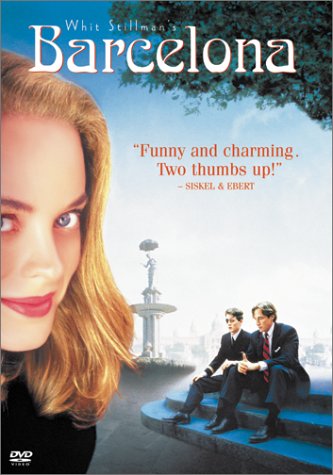
"Barcelona" (1994)

**It's "Whit Stillman Week" at the Worthy of Note blog.  Enjoy this review of “Barcelona” which is rarer (but paradoxically considered more popular) than the other two films.**

“Barcelona” is the second of Whit Stillman’s three ‘Doomed Bourgeois in Love’ art-house films, and it is a very different sort of creature than “Metropolitan” or “The Last Days of Disco.” It is less sedentary than the former, less exuberant than the latter. Its themes are far removed from either of its fellows as well: the primary subject is beauty and love, as opposed to truth or virtue, though the film also touches peripheral questions of tradition, initiative and prudence.

Directed by Whit Stillman, starring Taylor Nichols and Chris Eigeman.
Content warning: some scenes with sexual content, mild language, and drug use.
The film begins with a montage of scenes that introduce us to the setting – Barcelona, the last days of the Cold War – and to the primary themes of the film. A suave European admires his lady in the mirror, complimenting her figure: “perfecto.” Trade fair girls, dressed in red, walk primly down the streets of Barcelona, admiring friends and glaring at strangers. A bomb blasts away the windows of an American library. The pursuit of beauty, the question of friendship and love, and the phenomenon of anti-Americanism – these are the key and recurring motifs.

We meet Ted, an introspective and soft-spoken salesman with the Illinois High-Speed Motorway Racing Company, whose inner monologue serves as our narrator. The other main character is his cousin Fred, a very outspoken American officer who is in Barcelona as the advance man for the Sixth Fleet. Fred is oblivious to others’ feelings, but remarkably sensitive to his own: he is both self-conscious and easily offended. Where Ted has trouble acting on thoughts and feelings, Fred has trouble not doing so. Fred is almost invariably impulsive. He takes other people’s stuff almost without a thought: “borrowing” the consul’s high-quality wine, and leaving IOUs for money taken from Ted’s safe at home. This gets him into significant trouble later on.

At the start of the film, Ted is recovering from a deep funk, ostensibly from a bad breakup with the sight-unseen Betty, but more accurately because he is essentially rootless. Tradition is key to understanding this film, as in “Metropolitan.” The early discussion about the Sexual Revolution and the promiscuity of Spanish girls touches this theme early on: “The Sexual Revolution really affected these girls. It turned their world upside down.” Fred offers the (all too common) counter-argument: “Don’t you think it’s possible that the world was upside down before, and now is right side up?” Ted pauses, and responds simply: “No, I don’t think that.”

Ted has tried to craft his own tradition, drawing from his sales background, from the literature of self-improvement (Franklin, Emerson, Carnegie, and Bettger) and from religious sources. In one scene of muted hilarity, Fred catches him dancing alone in his apartment to swing music while reading Proverbs and Ecclesiastes. “What are you, an adherent of some weird Glenn Miller based religious ceremony?” Ted responds: “No, Presbyterian.” “Presbyterian?” “Well, Protestant, then.” Fred’s girlfriend asks: “Protestant churches are like these?” Fred replies: “Pretty much.” Putting aside the veiled critique of Protestantism, the dialogue confirms that Ted is trying to identify with a tradition, even while remaining ignorant of what that tradition actually is.

The central statement of this theme comes immediately after this scene. Ted is railing against his cousin for spreading rumors among the trade fair girls of his sexual fetishism. Fred replies: “You are far weirder than someone into S&M. At least they have a tradition! You have no tradition. We have movies and books describing what S&M is about; I have nothing telling me what you are!” Ted is stung, but must recognize the truth behind the words. In an world “turned upside down” by sexual liberation and socialist influences, it is ironically those former bastions of tradition that are the least recognizable as such. In a society without faith, religion is as great an innovation as atheism would have been in the staunchly Catholic Middle Ages.

Moving on from the question of tradition, let us now treat the issue of love. After his break-up with Betty, Ted realizes that his infatuation with her beauty had ruined their potential friendship. In one of the more delightful lines of the film, he tells Fred: “I’m beginning to reconsider my attitude toward female beauty. I think it’s very bad.” Fred mocks him for this, and for his resolution to “only date plain or homely girls,” but that doesn’t stop Fred from using it to his own advantage later. When they stumble across girls en route to a party, Fred maneuvers to ride with the one who looks like she stepped out of a fairy tale. Ted is left with the two girls who look like hags or witches from said fairy tale. Yet he hits it off with one of them – Aurora – and she invites him to a concert.

The concert is a disappointment: Ted thought it would feature Lionel Hampton (and thus, jazz) but he had only misheard her say “Vinyl” Hampton (a cacophonous atonal mess). Moreover, the lady never even showed, but Ted manages to enjoy the evening with her replacement, Montserrat (who is, ironically, gorgeous). And then he falls in love with her.

There is a five-second snippet of film that really struck me. Ted narrates: “Everything was completely different now.” On screen, however, we only see Ted walking alone down the same semi-deserted street we had seen earlier in the film. Nothing had changed, but everything was different all the same. Profundity ensued.

The next scene reveals that perhaps Ted had merely fallen in love with the idea of Montserrat, the fantasy of looking into her eyes and seeing her soul. Certainly he is disconcerted the next morning when he learns that she tells him about her old flame Ramon, who had seduced her when she was 16… and then reveals that they never broke up, that she’s living with him though they consider it an ‘open relationship.’ At this discovery, Ted’s flabber is properly ghasted.

The two cousins soon meet Ramon at a party. He is a journalist, who holds that “all the old gods are dead… but in beauty” (specifically “of the female face and form”) “the memory of divinity remains.” We realize that it was he at the beginning of the film, examining a woman in a mirror and exclaiming “perfecto.” Yet that image itself contains the germ of criticism, that his ideal beauty is strangely flat: he will not admire a woman unless it is to a reflection, even when the woman is in front of him. He cannot withstand the three-dimensional complexity of a real female, and must reduce her to two dimensions before he recognizes her beauty.

Yet in addition to this strange naïveté, Ramon remains a smug playboy, who invents stories to fuel the anti-American fire. He speaks with hilarious ignorance of the “AFL-CIA,” and how the U.S. came to Europe to crush the progressive labor movement under the Marshall plan. He claimed that the recent USO bombing (depicted shortly before) had been a CIA pretext for the Sixth Fleet’s planned invasion of Barcelona, as the bombing of the “Maine” had heralded the Spanish-American War.

Ted is angered by Ramon, and tries to persuade Montserrat to leave him and move in with Ted. However, after a disastrous picnic in which Ted tries to explain U.S. foreign policy by analogy to ants and is spectacularly misunderstood, Montserrat leaves with Ramon and spends the night with him. It turns out that Fred had planted the seeds of their breakup by implying that Ted was looking to marry – which, for a sexually liberated girl in Spain, was just plain weird. “I think it is fascist for a man to immediately talk about marrying a woman he likes." Fred responses with some bemusement: “I don't think Ted is a fascist of the marrying type.”


Fred had also planted the seeds of his own undoing by lying to his girlfriend about working for the CIA, which she had passed on to Ramon and Ramon had published in his paper. At the same time, Ted discovers that his safe had been emptied, and he blames Fred (who he knew had taken money from it earlier). Fred is booted unceremoniously from the house, and goes to his girlfriend Marta’s house to find other accommodations. It turns out that she’s the cheating kleptomaniac herself – Fred finds her sleeping with another man, with envelopes of money stolen from Ted. Fred leaves her house distraught, repeating the self-improvement mantras he had earlier mocked, only to be shot by a motorcyclist on the way home.

Fred is taken to the hospital and remains in a coma for most of the rest of the film. Ted had heard that the sound of voices might speed recovery, and so maintains a constant vigil in Fred’s room, reading books aloud to him. At first, only Aurora shows up, with her friend Greta, to help care for Fred. When Marta finally does show up, it is to demand the money Fred had on him, which he had taken from her apartment… and so Ted learns that Marta had stolen the money, and Fred had been on his way to return it.

Over the course of the next few days and weeks, Ted and Greta grow quite close. At one point, he asks for her to leave so he could pray for Fred; she mishears him, however, and gets on her knees beside him to join him in prayer. The two bond over books, art, faith, and a shared loathing of Ramon. But the moment is lost when Montserrat arrives and makes her excuses.

Fred does recover: he wakes up to hear Ted praying for him, and exclaims “Give me a break!” The rest of the film fairly flies by: Ted anxiously awaits the arrival of the firm’s Chicago-based marketing manager, thinking he’ll be fired, only to learn that the CEO is dying and that Ted will be groomed to replace him. In the course of narrating his now-frequent trips to Chicago, Ted mentions his impending marriage, though the lady isn’t mentioned. The film settles back in Barcelona, on the wedding day. Fred reveals to Ted that he’s fallen in love with a girl, but is following Ted’s advice and taking is “really cool.” At that moment, Ramon appears and offers a faux-apology for the article that had gotten Fred shot, but does offer to make it up to Fred. Fred takes him on the offer, though we don’t see how.

The final scene is set in Chicago, where Ted, Fred and Dick (the marketing manager) are grilling hamburgers for the Spanish girls, who soon discover that American hamburgers are much better than the European kind. Ted gets in the final word on anti-Americanism: “See, we’re not such idiots.” However, our attention is mostly focused on the outcome of the love-and-beauty plot, which more closely resembles the end of a Shakespeare romantic comedy. Ted is now married to Greta! Fred is dating Montserrat – she was the girl he’d fallen for, and Fred must have asked Ramon to give her up so he could date her. Even Dick gets in the game, and is now dating Aurora!

Although… Dick is somewhat confused about something Aurora said, about leather underwear and weekends of fun. We realize that Ted had pranked Dick with the same story Fred had used much earlier on him. This is a bit of a cathartic moment, as we realize that Ted is finally a bit more confident and comfortable in his own shoes, while Fred has become a bit more reflective. Both cousins had learned from each other, and realized the virtues that the other’s personality had reflected. In Stillman’s world, the greatest victory is to learn those virtues that come least naturally to you, and by that calculation the cousins’ victories are great indeed.

“Barcelona” is a quick-paced film in which very little happens, at least by the standards of more conventional films. It is a profound contemplation of love and beauty… that is by the same token quite muted in its emotional impact. It is a mess of contradictions, yet cohesive despite them, or perhaps even because of them. Stillman is a master at making you think, and by that measure this is a brilliant film indeed.

Favorite quotes (besides the ones written above):
-    “Self-affirmation is great in theory, but whenever I try to put it in practice I get really depressed."
-    “The United States is like the ant farm of the world…. But no one in Europe can observe the ants directly.  They must rely on journalists and reporters to describe the ants. The problem is that those people all seem to hate ants.”
-    “Literary critics are always talking about the subtext, which seems to be the hidden meaning of the book. But no one talks about the meaning that isn’t hidden, the meaning that’s right on the surface… what do you call that?” “The text?” “Right, nobody talks about that."

Monday, October 18, 2010

"Metropolitan (1990)

**It's "Whit Stillman Week" at the Worthy of Note blog.  This week, I'll be reviewing three films by one of my favorite directors, Whit Stillman.  I hope you appreciate the reviews, and perhaps even the films.**

Whit Stillman is a rather obscure director, who produced a trifecta of films in the early 1990's that received critical acclaim and accolades, and shortly thereafter disappeared from public review. Yet those three films convey some of the most profound ideas ever treated on the silver screen. Stillman presents a world that is simultaneously elevated and oddly realistic. He treats humans as they actually are -- with small moments of epiphany, catharsis and barely discernible movements of the soul -- and humans as we wish they were -- with rich interplay of ideas and complete sentences. It is a challenge to even approach these films, let alone to appreciate them fully, but comprehension is immensely rewarding when it comes.


"Metropolitan," Stillman's Oscar-nominated first film (1990, Best Original Screenplay), presents the rather insular world of New York youth in the midst of the debutante ball season. They are the self-identified urban haute bourgeoisie, preppies for short, and the film is driven by their conversation. The movie begins as the members of the "Sally Fowler Rat Pack" leave a ball to head to the after-party, and stumble across the rather lonesome Tom. They insist he join them, and so they all head to Sally's apartment for an evening of upper class diversions and pretensions.

Each personality on display is a truly delicious mix of sincerity and facetiousness, insight and utter ignorance. Tom, the newcomer, serves as our eyes in this strange world, and we find him to be just as lost in the confusion as we are. On the other hand, Audrey, the shy and soft-spoken fixture of the group, serves as our emotional anchor to this world. Tom and Audrey seem to be almost polar opposites, but in their conversation and mutual respect we find the themes of this film.

The centerpiece of "Metropolitan" involves the concept of tradition. These are children on the verge of adulthood, but the adults themselves are almost entirely absent. Of the three adults who actually appear, two are relegated to wardrobe (Audrey's mother hems a dress, Tom's mother prompts him to return his tuxedo) while the third is a stranger who joins the group's conversation but is quickly shunted off to the side. Theirs is a world without authority, without role models, without tradition.

That is not to say that adults don't loom large in their conversation, even in absentia. Audrey worries that her father “believes himself to be a failure; but I don’t think he is!" Tom's parents had been divorced for several years, and though he initially considers himself "very close" to his father, he discovers his childhood toys dumped unceremoniously outside his father's old apartment and discovers that his father had moved across the country without telling him. It is a heartbreaking image -- a son no longer wanted by his father -- and made all the potent by our previous realization that Tom is truly lost without an anchor.

Tom can boast an active mind, but he has little understanding or appreciation of the past. For instance, he doesn't read actual literature, but prefers literary criticism (under Audrey's tutelage, he discovers the value of a good book by reading Jane Austen). Audrey, on the other hand, appreciates convention, even though she doesn't fully understand it.One of the girls proposes a game such that the loser must answer truthfully any question put to them. Audrey objects, saying that people don't go around revealing secrets for a reason, and that the game could be dangerous. Others respond that they can't think of why not, but Audrey replies: "You don't have to! Other people have, and that's why it became a convention." The game proceeds over her objections, and secrets are revealed, including one particularly hurtful to Audrey. Her own wounds vindicate her argument: it is wise to follow tradition, even when and especially when you can't think of the reasons for it.


By first impressions, Nick comes across as the antithesis of Audrey: a smug bastard who gives himself airs and lashes others with a biting wit. Over the course of the film, however, he grows closer to Tom and we see more and more of his true character. Nick is as quick to listen as he is to talk: he insults everyone, but is able to empathize to a unique degree. At one point, he persuades Tom to remain in the group by pointing out Audrey’s emotional vulnerability, and noting that she might be hurt by Tom’s departure. In a conversation about, of all things, detachable shirt collars, Nick comments that so many things are abandoned with time that ought not be. Tom replies, "You're obviously talking about a lot more than detachable collars."

Even the ending reinforces Nick's centrality to Tom's transformation. Nick is caught in a lie that damaged another preppie's reputation (though his excuse that it was "a half truth. A compilation. Like New York Magazine does!" actually appears accurate). Nick is excluded from the group after that point, and disappears to visit his (divorced) father and (evil) stepmother upstate. At the train station, he bids Tom farewell, but reveals that Tom is the last of the old guard, the one person who uniquely relates to the values Nick holds dear. That is the emotional turning point for Tom, and inspires him to fight for Audrey's honor when called upon in the next scene.

It turns out that Audrey didn't need defending, but had undergone a transformation of her own. Under the influence of Tom, she had learned to take initiative and act with prudential virtue: she flexed her allegiance to convention, but remained constant to virtue in practice. She had gone into the lair of an amorous preppie, to serve as a chaperone for her friend. She had in fact been defending the honor of another, when Tom shows up. In confusion, Tom notes that it was not what her hero Jane Austen would have done, but her only respond is to smile and acquiesce. She knows, and accepts, the distinction.

By the end of the film, the kids have grown up. From within their authority-less microcosm of modern society, they overcame the saccharine naïveté of their youth and latched onto a tradition and a mature mode of behavior. This is no "Peter Pan," no fantasy of eternal childishness. But nor is this "The Breakfast Club," in which adulthood is found through self-discovery. Indeed, defeating the misguided morals of the Brat Pack film may be considered at the heart of Stillman's work, particularly his final film "The Last Days of Disco." Rather, it is through a sense of tradition, of obligations to the social order, that the children find virtue and thus find happiness.

It is something of a joke that arthouse films are those in which nothing happens: they sometimes lack the sort of grand story or overarching plot for an audience to follow. Yet Stillman's films portray a much richer story than those of other films. Most are content to depict essentially archetypal characters reacting to events -- the stories occur externally, whether from changes in fortune, love or situation. The personalities rarely change as a result of events, and if they do the changes are generally superficial. Stillman depicts essentially real humans (if they are admittedly idealized conversationalists) who learn from minor events and grow as a result. The story occurs internally, and the movements of personality are complex and sometimes ineffable. If the results can be expressed at all, it can easily require an essay to fully comprehend. "Metropolitan" is one of those films that requires and rewards multiple viewing. Stillman treats film as a canvas for truth, not beauty, yet creates beauty through the characters developing their own humanity.

Thursday, October 7, 2010

"Bride and Prejudice" (2004)

**After reviewing the novel and two direct adaptations, I'm now going to move in a completely opposite direction and review this 2004 Bollywood take on the classic Austen story.  This will be my last review for "Pride and Prejudice Week;" there is are other films and a 1980 BBC miniseries that deserve some attention, but I lack the time to do them justice.**

It's really hard to even know where to begin in reviewing a film like this.  "Bride and Prejudice" conveys so much infectious joy that it's hard to stop smiling long enough to start writing. It encompasses so many themes and genres that it's even hard to describe it. I would encourage you to read Roger Ebert's review of the film; that is probably one of the best reviews by him that I've read, and certainly one of the most enjoyable for its own sake


"Bride and Prejudice" is a Hollywood-made musical incorporating the plot elements of an Austen romance and the cinematic elements of a Bollywood comedy. It's almost frightening how well it plays both roles. Ebert notes that the director "employs the Bollywood strategy for using color, which comes down to: If it's a color, use it." As a musical, this film is brilliant, though the Indian songs are much more enjoyable than those sung in English. On the whole the script knows when to thumb its nose at itself and at the conventions of the genre. Entire streets of people suddenly burst out with song and dance, and two tubas materialize out of nowhere to play a few notes. My jaw quite literally dropped when I saw a fully robed Southern Baptist choice appear on the beach where Lizzie and Darcy had gone for a date, singing the background vocals while the couple falls in love.There is the obligatory "random celebrity singing an unrelated song" in true Bollywood tradition, and even a quasi-Hong Kong action set-piece (brilliantly set in a theatre with a real action film playing in the background). However, since my main focus is on the novel, I'll limit myself to mostly noting how it works as an Austen adaptation.

Aishwarya Rai (who I'm contractually obliged to describe as "the most beautiful woman in the world") plays the main character, Lalita Bakshi (which is as phonetically close to Lizzie Bennet as one could reasonably expect). She lives with her family in Amritsar, India, which is here depicted as a country town along the lines of Austen's Meryton. The original setting of the novel, England in the Regency period, was dominated by family dynamics and strict modes of etiquette. Considering that India was (until relatively recently) a British colony with similar social norms and family dynamics, I was quite impressed with how well the transposition of the story to India worked. As for main family, of the original five Bennet daughters, only four remain in the Bakshi  family -- Kitty (who in other films exists merely to tag along with Lydia) has been struck. I don't mind the omission; given how poorly Kitty is handled by other adaptations, I think leaving that character out entirely is almost preferred. Jaya (Jane Bennet) is a serene beauty, Maya (Mary Bennet) is overly serious, and Lakhi (Lydia Bennet) is overly silly. Their mother, Mrs. Bakshi, is quickly established as a gossipy matron with more in common with Lakhi than her other daughters, while Mr. Bakshi is the dryly droll dad.

At a friend's wedding, Jaya and Lalita meet Mr. Balraj, a British-educated Indian, and his friend William Darcy, the fantastically rich American hotel-owner. This is probably the best aspect of the film, from an Austenian point of view, simply because they reflect the original characters so well. In the novel, the Bingley family had recently acquired their fortune by trade (which is why Bingley was purchasing Netherfield Hall to begin with), while Darcy's family could boast far more elevated and ancient roots. For this reason, Bingley becomes Balraj, an Indian character with similar roots as the Bakshi family, while Darcy is played as an American, hilariously out of his depth. The depiction of Darcy is spot on: he is socially awkward, but comes across as arrogant. In an early scene, the drawstring for his pants comes undone, forcing him to make his excuses for not dancing with Lalita. It's a great piece of physical comedy, but it also allows us to see how he is simply uncomfortable while she reads him as stand-offish.

The story follows the expected Austenian lines, though the lines themselves are significantly less witty than the original. Lalita is determined to despise Darcy, despite his efforts to impress her. Mr. Wickham (this time named "Johnny") rises with a bronzed physique out of the ocean surf and immediately impresses her with his charm. The film presents Wickham as a much more viable love interest than most other adaptations, rather than the merely lukewarm regard Lizzie has for him in the novel. As for the inimitable Mr. Collins, he is transformed into Mr. Kholi, a Silicon Valley entrepreneur returning to his Indian home looking for a bride. Rejected by Lalita, he soon proposes to her best friend Chandra and returns to Los Angeles. The girls follow for the wedding, and so the courtship (and inevitable misunderstandings) can continue. Lalita meets Catherine (here treated as Darcy's mother, rather than his aunt) and Darcy's sister Georgina (played by Alexis Bledel, taking a break from her seven-year stint on "Gilmore Girls").

The film makes an interesting choice by treating the courtship of Lizzie and Darcy more extensively here, and allows Lizzie to actually develop feelings for Darcy during this time. Afterward, Lalita is naturally flummoxed when Catherine introduces Darcy's "girlfriend" Anne, and appalled when Georgie tells him that Darcy separated Balraj from Jaya because he thought her mother was a gold-digger. Lalita flees to Britain with her family, where Lakhi (Lydia) runs off to the carnival with Wickham (a much tamer version of the novel's "she elopes with him"). Darcy appears and reveals that Wickham had tried to force his way into the Darcy family fortune by getting Georgie pregnant when she was only 16 (a much more extreme version of the novel's "he tried to elope with her"). Darcy pursues Wickham and fights him for Lakhi's honor and brings her back to the Bakhi family -- there isn't a duel in the novel, but it seems strangely appropriate (especially given the duel under similar circumstances in "Sense and Sensibility").  By the end of the film, Jane and Balraj are getting married, and Lalita and Darcy are engaged -- happy endings for all.

It is really quite difficult to judge this film by the standards of other Austen adaptations. It makes no effort to rigidly follow the text, which does cause problems in some instances. Lalita and Darcy go on a few dates while she is in Los Angeles, which pushes the period of their courtship forward considerably. The film doesn't seek to make them hate each other, but is content to rely on simple misunderstandings and poor judgment to supply the obstacles for the lovers to overcome. The logic isn't as strict as Austen intended, but then, it's a Bollywood film, so I couldn't really expect any more. The joy and exuberance underlying the novel are decidedly present, and that is the greatest virtue of the film.

Wednesday, October 6, 2010

"Pride and Prejudice" (2005)

**Here is my third review for "Pride and Prejudice Week," this one for the 2005 film with Kiera Knightley and Matthew MacFayden. I will likely be tarred and feathered for these opinions, or at the very least ostracized from the ranks of Austen loyalists, but such is life.**

It is a truth universally acknowledged, that a classic story in possession of a blockbuster film must be in want of a remake.  After the resounding success of the 1995 BBC adaptation  of "Pride and Prejudice," starring Colin Firth and Jennifer Ehle, it was almost inevitable that the ensuing wave of Austen-mania would reach Hollywood. Somewhat surprisingly, no one wanted to compete against the original with a straightforward adaptation, so most films based on the novel were reinterpretations, either chronologically or geographically displaced from the original setting.  It wasn't for another ten years that a newcomer to Hollywood, Joe Wright, would actually attempt a direct remake of the novel.


Let's get something out of the way first: it is a tad bit unfair to compare a two hour Hollywood film to the BBC adaptation. These are different media, and it simply is not possible for the film to be anywhere near as a faithful to the novel as a six-hour miniseries marathon. The fact that the producers of the 2005 film managed to condense a tightly written novel down to two hours while preserving the narrative sequence and many of the best lines (including many that were excised from the 1995 script!) is immensely impressive, however you cut it. The omissions and inaccuracies in the 2005 film may be readily excused as an inevitable by-product of the running time. The real question is, how did this film deal with the material within those time constraints?

The 2005 film was marketed pretty directly as a romantic comedy, and tended to shy away from the "period piece" description. This led to several artistic licenses with the text that were pretty widely decried by the loyal adherents of the 1995 film, and I admit several of those licenses made me queasy. For instance, the setting for Darcy's second proposal was moved from a country lane in midday to a lush meadow in a misty dawn. I laughed quite a bit when I first saw that scene, for it was so unbelievably cliched. The epilogue (which only appeared for American audiences, Lord love the British) was also nauseatingly cheesy. On the other hand, the epilogue did occur after Darcy and Lizzie were married, which almost redeems it in my book. So many adaptations of Austen novels are content to end with a declaration of love, or with a wedding, where Austen is generally pretty careful to show the couple in their married state.

There were other stylistic decisions that riled the Janeite community. One common complaint was that the costumes weren't authentic to the Regency period. In the film's defense, the producers apparently intended to set the story in 1797, when fashion in the (slightly earlier) Colonial style would have still been common among the lower gentry, while Miss Bingley and the elite would have dressed in the more up-to-date Regency fashion.  I am not an expert in Regency fashion, and do not particularly care to be, and am therefore somewhat apathetic on the subject.  I cannot fault the film for slight anachronisms of style, when the story and characterizations weigh so much more heavily on my mind. In a similar vein, many Austen loyalists noted that Lizzie's home is so dirty that it could hardly be called the house of a country gentleman: perfect order was considered the sign of beauty (a baroque and classical sensibility), and disarray was not considered picturesque until much later, under the romantic and impressionistic influences. Both choices were deliberate, since the film's director wanted to move away from the staid environment of a "period piece" and make the setting more relatable to modern audiences.

Due to the limits of time, several minor characters were cut out or greatly reduced in importance; however, of those who remain, I think I prefer this version's treatment of them to that of the 1995 adaptation. The 1995 version was so leisurely paced that the humor became somewhat muted; to preserve a sense of fun, the minor characters were obliged to become caricatures, and were played for laughs. The harried pacing of the 2005 film preserves the quick wit and pace of the novel; thus, I think it is paradoxically due to the time restraints that the minor characters were given enough room to shine.

My favorite minor character in the film is Georgiana, Mr. Darcy's younger sister. She is described in the novel and in the 1995 miniseries as shy. In sharp contrast, the 2005 version makes her an energetic companion to Lizzie: this is not entirely like the book, but is true to Georgiana's "eager[ness]... to be pleased" that is not so readily shown in the 1995 version. Moreover, the 2005 film brilliantly depicts the affection between her and her brother, and we get a real sense of the family bond that they will share with Lizzie after the end of the book. Also, it should be said that the knowing glance she casts to Darcy when she meets Lizzie for the first time is absolutely brilliant. It is hinted in the novel that Darcy had spoken to her about his feelings for Lizzie, and this is the perfect 'younger-sister' look that conveys that back-story.


The members of the Bennet family are likewise cast in a much superior light. Mr. Bennet is given a more compassionate edge -- less of an insensitive outsider who only cares to laugh at his family, and more of a sensitive father and family participant with a keen sense of humor. He consoles his daughter Mary after her disastrous performance at the Netherfield Ball, and at the end of the film we get a glimpse (thanks to a brilliant performance by Donald Sutherland) of his true affection for Lizzie. The characterization of Mrs. Bennet is almost an infinite improvement on the 1995 version: she is still played for laughs, but she depicted in a much more reasonable light. This is, in my mind, truer both to Austen's original description, and to the social realities which would produce such a character. Their daughter Mary is likewise almost infinitely better than the 1995 version's view of her. Mary is plain, and self-conscious about it; she is neither pretty nor accomplished, and is overshadowed at every turn by her sisters. She desperately seeks attention, and wishes to perform for that reason, but she hasn't received the guidance to enter society gracefully. This is no self-righteous prig; this is a young girl trying to grow up.

I liked Mr. Collins far more in the 2005 film, and that is to its credit. He is odious, of course, and we are intended to dislike him for his obsequious attentions to Lizzie, but we cannot forget his essential good nature. He is, after all, introduced into the novel because he wants to repair the breach between his late father and Mr. Bennet, and his design to marry a Bennet girl is an attempt to let the Bennet family partake in the estate after their father's death, to make amends for the unfortunate entailment that would have otherwise deprived them! Mr. Collins is low-born and overwhelmed by the sensation of Lady Catherine de Bourgh’s generosity to him (as well as her rank and general formidableness), so it is not surprising that he praises her over-much. He is a comic creation, but we must not forget that he is hardly one-dimensional.

As for his wife, the former Charlotte Lucas, the 1995 version greatly annoyed me by treating her as essentially mercenary, who married Mr. Collins solely for the comfortable living.. The 2005 film did a much better job of depicting her desperation, from living on the verge of becoming an old maid, and her good nature. I felt as though the 1995 version made her friendship with Lizzie almost a mystery, they had so little in common, but the 2005 film went a long way in correcting that mistake.

As for the two leads, it must be said that neither can compare to the main characters in the 1995 version. They simply don't have as much time to make a clear impression. While I concede freely that Kiera Knightley was not the best choice for casting Lizzie, it was not as disastrous as some might say. Jennifer Ehle had six hours of screen time to establish Lizzie's good nature through small brushstrokes -- discreet and knowing glances, a brief scene of playing with Bingley's dog, etc. Kiera Knightley did not have the luxury of a understated performance, and was obliged to establish Lizzie's good nature within a shorter span. I felt Knightley's portrayal was a bit freer, more relaxed and perhaps even quicker to laugh, than Jennifer Ehle's. She has been criticized quite a bit for her performance, but I cannot condemn it so readily.

As for Matthew MacFayden, he must suffer in comparison to the definitive performance of Colin Firth, but in one respect he was superior. MacFayden much more clearly conveys Darcy's essential awkwardness and shyness from the beginning, which is in fact true to the novel. We can see why Lizzie would despise him, but we get glimpses of his true nature earlier on and therefore understand both his true nature and Lizzie's misapprehensions about that nature. The 1995 version follows Lizzie's perspective quite closely, correcting her mistakes as she does, but this has the disadvantage of making his ultimate conversion into a romantic hero somewhat befuddling (and also comes perilously close to the classic romantic comedy error of letting the heroine "change" the hero from his former "bad boy" persona). In the 2005 version, Darcy is given the chance to defend himself, particularly in the first proposal scene, where he acquits himself of Lizzie's attacks on the subject of Jane and Mr. Bingley quite well. While we understand Lizzie's resentment, we sympathize with Darcy, and that is essential to understand the novel.

I cannot heap enough compliments on the cinematography, and the soundtrack is absolutely perfect. Given the fact that almost all of the music is original, it is stunning in its resemblance to music from the period. These two aspects go a long way in accentuating the other virtues of the film. It is not a period piece, but that was not its intent. The film conveys the essential joy of the novel in a way that cannot be adequately expressed within the staid environment of Regency England. It should be remembered that the settings of medieval fairy tales were originally very familiar -- castles and cottages were as as common as cars today -- and did not become exotic until much later. Likewise, the atmosphere of the times would have been familiar to Austen's readers: they would have had no difficulty in relegating the setting to the background. Today, however, the setting is so foreign to modern readers that it almost invariably dominates our impression of the novel. By removing that 'period' atmosphere from consideration, the 2005 film offers a different (and in some instances clearer) perspective at the underlying characterizations and story.

Sunday, August 22, 2010

"Shutter Island" (2010)

“Is it better to live a monster, or to die a good man?” With these words, Leonardo Dicaprio ends “Shutter Island” on a profoundly ambiguous note. Like one of those “Choose Your Own Adventure” books from our childhood, several scripts have been written, but we as the audience are given the choice between them. Since revealing details of the film seems to me the only way to effectively explore that ambiguity, I am issuing a severe spoiler alert for the states of Kansas, Nebraska, and parts of Missouri. You have been warned.


Leonardo Dicaprio is introduced as Teddy, a federal Marshal traveling by ferry to Shutter Island, an asylum for the most dangerous of the criminally insane. He is investigating a recent escape by one of the female inmates. We soon learn that Teddy had requested this assignment, and that he believes the medical staff at Shutter Island are conducting secret experiments on the inmates with psychotropic drugs and brain surgery. He later meets the escaped inmate, who reveals that she had been a nurse before she learned of the experiments, and had been forcibly committed to discredit her accusations against the institution.

Before finishing the plot summary, I want to review the film up to this point. My first impression of this film was not a favorable one, mostly due to the soundtrack. The film itself starts off with Teddy meeting his new partner Chuck on the ferry ride over to Shutter Island, and their entry through progressive rings of the institution’s security. These are beautiful, almost serene images, and a credit to the direction of Scorsese. The music, on the other hand, starts off as though it were already the climax: it is loud, dissonant, and unrelentingly cacophonous. It's hard to imagine anything more brazenly manipulative than those first five minutes of film -- yes, that includes the finale episodes for any season of "American Idol." Fortunately, things improved: the music was toned down and interspersed with more classical oeuvre, while the cinematography was amped up and given actual dramatic heft. The movie itself begins to live up to those dissonant notes from its opening, though, when Teddy begins to experience migraines and wrestles with his memories from the liberation of Dachau. The interspersed images contribute greatly to the sense of tension later in the film.

After bidding farewell to the escapee, Teddy realizes that his partner Chuck is missing, and suspects that he has been abducted for psychiatric experimentation. While investigating an abandoned lighthouse, he meets the head of the medical staff, who tells him that Teddy has been a patient at Shutter Island for the last two years. His partner Chuck was in fact his primary-care psychiatrist. Teddy had concocted a fantasy of being a U.S. Marshal to avoid dealing with his traumatic past: his wife had killed their three children, and had died at his hands in the aftermath. Teddy is in fact scheduled for a lobotomy, unless he comes to terms with his own past. For a few brief minutes in the film, he does remember, but the next day he appears to have re-emerged into this fantasy. But before he can be carted off to the lobotomy, he looks at his "partner" and asks him: “Is it better to live a monster or to die a good man?” He then picks himself up and walks away with the medical staff.

There are three possible interpretations of this ending, as I see it. The first ending is the most evident one: Teddy is an inmate, who relapsed into his fantasy. The second ending, which is more plausible and more intriguing, is that Teddy did not relapse. He realized he had killed his wife, and had doomed his children by ignoring her mental condition, and could not live with the knowledge of what he had done. He had already been told that if he relapsed he would be lobotomized, so an easy escape offered itself naturally to his mind. Deceive the staff, erase the memory.

The third ending is less plausible, but much more intriguing, simply because it disregards the final twist as a ploy by the Shutter Island staff. We know that they had been feeding him drugs throughout the film, and that they’d fed him a story about an inmate who killed her three children, so how hard is it to imagine that the “memories” of his dead wife and children were themselves hallucinations spurred by the power of suggestion? In this reading, Chuck was a plant by the Shutter Island staff to play on Teddy’s sympathies and create a more dissonant denouement, a tension that forced Teddy to reconcile through those imagined memories. This might also explain why one of the female inmates wrote “RUN” in Teddy’s notebook when Chuck had left to get some water – she knew the island was a trap set for him, and that Chuck was in on it.

It can readily be seen why this movie would be compared to “Inception,” Leonardo Dicaprio’s other thriller of the year. Both movies play with the ideas of mind and memory, and toy with their audience’s understanding of reality. The final shot of the spinning top –the momentary wobble, or is it just a visual trick? – truly underscores the ambiguity at play in both films. Was it all a dream, or all a hallucination? Or, if there was some reality presented in this film, where do we look for it? However we interpret the film, it performed admirably in provoking thought and question about the psychiatric profession. Most films are content to foist an imaginative vision upon its audience, but these films leave off those final pieces to the puzzle, and expect its audience to participate in the creative act. While I doubt I would watch this movie over again, it is a pleasure to puzzle over the mysteries it presented.

Friday, August 20, 2010

"Music and Lyrics" (2007)

There are two ways to watch the movie Music and Lyrics. The first is to treat as crass commercialization of romance. This is made particularly easy, as neither the screenwriters nor the actors wander anywhere beyond the strictly comfortable for this venture. The second way, as I prefer, is to view it as a labor of love. Despite the stock characters and hackneyed plot, there is a simple underlying principles that defines this movie: those who made it have a deep and abiding affection for music. This is what makes this film bearable and indeed enjoyable.


Let’s first speak of the plot and the characters. Neither will take long. Hugh Grant plays his stock “perpetually droll man-child,” in the form of a fading star from the early 90’s band, who spends his life singing at high school reunions. He is paired with Drew Barrymore’s stock “slightly neurotic yet empowered lady,” in the form of a disaffected English major who is found to be a natural lyricist. As can be readily predicted, they are forced together for an arbitrary yet urgent reason, quickly grow to love each other, fall apart for some equally superficial reason, and inevitably get back together when he makes a spectacle of himself. If we’re lucky, we might even get a Profession of Love in a Stadium cliché, which is always fun to laugh at (that’s assuming, of course, that you’re not the type to wipe away tears on such occasions, in which case you really ought to see a doctor about that).

Anyone who goes to this movie expecting high art and social drama deserves to be certified. This is not even a movie for those expecting high-quality cinema: there is one scene, set in a coffee shop, where the editing is so abysmal that our family started counting how many errors there were between shots. Yet I enjoyed this film, and I would even recommend it to others.

Music and Lyrics begins on an absolutely delightful note: a parody of all those awful music videos of the pop bands of our childhood. If you haven’t seen it, you really must. It is an affectionate parody, gently mocking the sheer ridiculousness of the sets and costumes and acting, but doing its best to replicate the infectious joy and sincerity of it. Likewise, the depictions of the music industry are just biting enough to constitute satire, while treating the music itself with respect. The scenes involving the pop star Cora Corman (a sexualized teen singer who advertises her karmic bona fides) are particularly delightful, and Hugh Grant is perfectly suited for the passing remarks about her “Buddhism in a thong” approach to performance. Yet even in these scenes there is an undercurrent of affection for the music on display.

The screenwriters may not have spared the time, but the musicians seemed to spare no expense. The main theme (“A Way Back Into Love”) is presented on many occasions, starting as a single melody line plucked out on a piano, then with the incremental addition of instruments and vocals, with the lyrics revealed in bits and pieces throughout the movie, then finally in the chorus at the end. Even the “Pop!” parody songs appear as the genuine article: they may not be worthy of the Beatles, but they are certainly what we might have expected from the Backstreet Boys or (Heaven help us) the Jonas Brothers. The music is not great, but it doesn’t have to be: it is well-suited for the movie's purposes.

The characters are developed only to the extent that the actors have been developing them for their entire careers, and the plot is especially perfunctory towards the end. Yet this is a film that will make you smile and laugh. It conveys a profound sense of joy, and an abiding affection towards the phenomenon of pop music – music that all of us at one point enjoyed and of which we all later repented. It is a universal human experience, to wince at one’s own insipidity, but this movie defangs that experience by turning it to a source of laughter. As John Adams once said (and this from a notoriously staid, almost Puritanical figure), “I cannot contemplate human affairs without either laughing or crying. I choose to laugh.”