Showing posts with label *novel. Show all posts

Tuesday, October 12, 2010

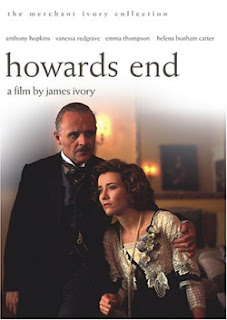
E.M. Forster: Howards End

**This review was contributed by another new guest author, Thunderfist, who takes his name from the hero of C.S. Lewis' classic travelogue "A Horse and His Boy."  Enjoy!**

Although Howards End is one of my favorite books, it often slips my mind when I think about English literature. Part of the reason for this is that its author, E. M. Forster, occupies an in-between time in world history: the close of the nineteenth century and the beginning of the twentieth. Victorianism was on the wane but World War One had yet to destroy Victorian and Romantic ideals. In a sense, Forster’s oeuvre in general reflects this transition: A Room with a View, published in 1908, is a novel of the nineteenth century, a traditional comedy of manners set in Italy and pastoral England. Published eighteen years later, A Passage to India is a dispassionate, modern depiction of British colonialism in India. Separating these two novels in the oeuvre is only Howards End, which captures the poignant transition between two very different centuries.
I have a long history with Forster: when I was fifteen I watched the classic film adaptation of A Room with a View and fell in love with its gorgeous portrayal of Edwardian England. From the rich and ceremonious dinners to the long sweeping gowns to the gaslamps and open carriages, A Room with a View is a period piece par excellence. The novel is a delight of witty dialogue and tongue-in-cheek narrative, following the tradition of Jane Austen. It portrays a sunny world of youth in which relational conflicts are easily cleared up with heart-to-heart honesty and a final surrender to true love; and its characters play tennis, drink tea and go on picnics in Arcadian countryside scenes.

In a conversation with the Supreme Arbitress of Taste, we agreed that A Room with a View is a novel of Forster’s youth whereas Howards End is a novel of his maturity. Written only two years later, Howards End is set in cosmopolitan London and focuses on a cultured, artistic family of two sisters and one brother. In an echo of Austen’s Sense and Sensibility, the older sister, Margaret, is a sensible woman who tempers her deep feelings with practicality, and the younger sister, Helen, is an emotional and romantic woman whose feelings draw her into other people’s troubles. These women become friends with two very different families: the rich and businesslike Wilcoxes and the poor, struggling, but sensitive and artistic Leonard Bast and his wife. Both families draw on the Schlegels’ sympathy: Mr. Wilcox loses his wife, Ruth (also a friend of Margaret’s), and Leonard Bast is threatened with hopeless poverty and unemployment. The famous epigram of the novel is “Only connect…” and the novel is indeed about different isolated clans within the social and economic structure of England, whose only connection is the Schlegels.

The Schlegel girls occupy a place of freedom in the novel because they were born independently wealthy and have never been exposed to the hard, pragmatic aspect of making money. As their loyalties to the Wilcox and Bast families are taxed by love and misfortune, the underlying truths about both love and loyalty, about romantic ideals and real life, are questioned. At the center of the novel is a house, Howards End, a little old country house that becomes a point of contention between the Schlegels and the Wilcoxes: it belongs to Mr. Wilcox but, as his wife’s property, is left to Margaret upon her death in a note. At a glance, the novel seems like a large jigsaw puzzle with the pieces easily fitted into place: Howards End represents England and the three families respectively represent the business class, the artisans, and the common folk. Who will inherit England?

But Howards End, both the novel and the house it takes its name from, are much more than that. They are an emotional and spiritual evocation of England and the people who already live in her, none of whom really “own” her but who must fight for and against each other in the struggle to love her, preserve her, and change her. That Forster wrote the novel in 1910, only four years before the First World War, adds an unintentional poignancy to the story: for this world in which the families’ struggle takes place is itself on the brink of traumatic change.
Howards End, though not considered Forster’s greatest novel academically, is probably his most famous and popular. The epigram “Only connect…” is deservedly often alluded to by the literary world, and contemporary British author Zadie Smith wrote her novel On Beauty as an homage to Howards End. In this sense, “Only connect…” functions quite literally, for Forster’s novel indeed forges connections across centuries and different literary movements, from Austen’s neoclassical Sense and Sensibility to Smith’s postmodern On Beauty.

Of course, the real worth of Howards End lies simply in its literary beauty. Forster’s turns-of-phrase, his descriptions and his superb characterizations give Howards End a poetic depth that is both modern and timeless. It is Forster’s swansong, his elegant, elegiac depiction of a world caught between Romanticism and Modernism, ideals and disillusionment, love and family loyalty, single-minded truths and over-arching truths. It precipitates Modernism with its own simplified but still romantic style, forging a beautiful complement to both past and future literary movements while avoiding complete attribution to either.
After this glowing review, I must admit I have mixed feelings about Forster. He has a distinctive voice that sometimes grabs me and sometimes leaves me cold. Only three of his stories resonate with me, and of those three A Passage to India, often deemed his greatest work, is a story I admire while finding it difficult to read. Forster’s early work has never caught my interest, but these last three novels, and for me personally A Room with a View and Howards End, achieve a particular kind of gorgeousness that comes from the very Forsterian voice that I occasionally have trouble with. In these two novels Forster's style becomes not only admirable but deeply touching. A Room with a View, whatever its immaturity, is nonetheless a perennially lovable romantic comedy; and Howards End achieves a quiet greatness with its subtle and graceful insights.

As an addendum, Merchant-Ivory’s film adaptations of A Room with a View (1986) and Howards End (1991) both rank as some of the best film adaptations I’ve ever seen. David Lean’s version of A Passage to India (1984) is also well worth watching.

Monday, October 11, 2010

Kathryn Stockett: The Help

**This guest post was contributed by Bookwyrm, an literature devotee who will be joining Worthy of Note as a regular co-author. Look for more reviews from her in the coming months!**

The Civil War was fought in the 1860s, right? Well, maybe it was the ‘60s, but Kathryn Stockett’s novel The Help suggests that it was the 1960s. The book tracks the stories of three women—two black, one white—trying to make a living and do the right thing in the time of the Civil Rights movement. But their war is not fought on the front lines in Washington D.C. They bring the battle home, to the working relationship of black domestic servants with their white employers. This book is the story of an alliance between these women to treat people as people, no matter their color.


The winds of change are blowing in 1962. Rosa Parks has refused to budge on a bus, and Martin Luther King, Jr., is on the march to D.C. But in Jackson, Mississippi, there is an equally strong push to keep things the way they’ve always been. White women get married, set out the family silver on the table, and hire black maids like second-class citizens to clean their houses and raise their children. The Help gets inside their parlors and segregated bathrooms to find out what it was like.

Aibileen is a black woman of mature years. Employed as a maid all her life, her favorite part of the work is taking care of her employers’ children. She has raised 17 babies in her life, but none for more than a few years. She makes a point to resign her work at the time when the children come to realize the divide between black and white—when they no longer see her as a person. At the start of the book, she is caring for Mae Mobley, her 17th white child, and she determines that this little girl is going to be different.

Minny is Aibileen’s best friend: younger, sassier, and with five children and an alcoholic husband to support on her working salary. Her sharp tongue has gotten her fired more times than she can count, but she, too, has a story to tell. Working as a maid since she was a teenager, Minny learned from her mama how to clean a house and make a good caramel cake. But when she sees something wrong, she wants to say something about it, and there isn’t room for that attitude in Jackson.

Miss Eugenia “Skeeter” Phelan is twenty-three years old and a college graduate: a rare position for a woman in 1962 Mississippi. Her mother is afraid that her brains will ruin her chances of ever catching a man, but all Skeeter cares about is writing. Hairspray, clinking teacups, and catty society gossip make her long to get out of Jackson and be an editor in New York City. But for a single white woman with no independent income, that dream seems out of reach.

That is, until she starts talking to Aibileen and Minny and realizes that these women have stories to tell. She starts waking up to their world: a black man is shot at his home for leading an activism movement. Aibileen’s son is killed in a preventable accident due to white neglect. Black maids are imprisoned on a white woman’s word if they know too much. Yet the entire next generation of Jackson society is being raised by women like Minny and Aibileen, who have learned to keep their mouths shut or lose their futures. It’s time somebody said something about it. But Skeeter, Aibileen, and Minny have everything to lose. Skeeter has to decide whether to let herself be carried along by the status quo or stop and stand against it.

Although the themes of this book hit hard and close to home, its vibrant detail makes it engaging and endlessly readable. Stockett writes about the South with a familiarity that only a native daughter could capture. I could feel the sticky heat, smell the fried chicken cooking, and watch the okra growing in Aibileen’s garden. Their world is drawn in such distinct colors that there is no way it could be anything but real. It sweeps away the Leave It to Beaver façade of the late 50s-early 60s and dives deep into what was really going on in the ballrooms and tennis clubs and screened-in porches of the South during the Civil Rights Movement.

In the epilogue, Stockett explains that her vivid descriptions come from firsthand experience. She grew up in Jackson, Mississippi, and was raised by a black maid named Demetrie. While no novel is a verbatim record of experiences, Stockett lets the tenderness of that relationship spill over into the personalities of the many maids in the book. They are captured like portraits done with a fine pen, free of generalizations and stereotypes. They are people so real you could send them a Christmas card.

This is a story about deciding whether to do what’s comfortable or what’s right. It doesn’t disguise the consequences: brave people don’t escape from suffering in this book. In fact, brave people are often those who suffer most, at least in the short run. But The Help made me feel almost like a visitor from the future, because now I can see the difference made by people who chose to go against their entire culture and treat all people like people.

**Bookwyrm is a bibliophile born in the wrong century. A native Californian, she is pursuing an English major at Seattle Pacific University. Her current job titles include editor, reporter, novelist, and freelance writer. When she’s not at work on a children’s novel or her senior thesis, she enjoys cooking, hiking, Irish music, old bookstores, and collecting technicolor socks.**

Tuesday, October 5, 2010

Jane Austen: Pride and Prejudice

One of my co-bloggers has posted a literary review of Jane Austen's "Pride and Prejudice" on her blog, Seeing Sepia. It's an opening salvo for a series of posts she'll be writing in response to my own.  We disagree vehemently on the merits of certain adaptations, so I can hardly wait.  This post, though, is insightful and delightful, and I'd highly recommend you check it out.  I've posted a brief excerpt below:

Jane Austen has the distinction of being a classic author who's exceptionally fun to read. This makes some critics dismissive of her merits, but I beg you not to sell her importance in the literary world short just because she only wrote romantic comedies. Her works both transcends that genre and in doing so becomes its canon to the point that most romances today are just different iterations of the plots she formed. To use a food analogy, if ordinary romantic comedies are like Dreyer's brand ice cream, full of artificial flavors and high-fructose corn syrup, then Jane Austen is two scoops of organic Sicilian lemon cheesecake gelato.
To finish reading her post, click here.

Monday, October 4, 2010

Jane Austen: Pride and Prejudice

**It's 'Pride and Prejudice Week' here at Worthy of Note!  For no particular reason at all I've decided to review the novel, and several of its adaptations, over the course of the next week. Tomorrow I will be posting a review of the epic 1995 BBC miniseries starring Colin Firth and Jennifer Ehle, and after that I will be reviewing the much-maligned 2005 adaptation starring Matthew MacFayden and Kiera Knightley. My fondest hope is that these reviews may upset my fellow Janeites sufficiently to vehemently critique me in the comments.**

"Pride and Prejudice" is one of the most recognized titles in English literature. Released to almost universal acclaim, the novel has preserved its ascendancy in English literature for the past two centuries. It has been adapted for a BBC miniseries on six separate occasions (1938, 1952, 1958, 1967, 1980, and most famously in 1995). It has also been brought to the silver screen five times, including two direct adaptations in 1940 and 2005, and three reinterpretations which placed the story in such settings as modern England (2001), Utah (2003) and India (2004). In 2003 it was rated the second best-loved book in the United Kingdom, only behind Tolkien's fantasy epic "The Lord of the Rings," and was the top pick among Australian readers in 2008. The world has Jane Austen fever.


If you don't know the story of this novel, I am heartily ashamed for you. Here's the short version: boy meets girl, girl despises boy, boy proposes to girl, girl rejects boy, boy is kind to girl, girl begins to like boy, boy marries girl.

Now for a bit more involved summary. Elizabeth Bennet, the second daughter of a country gentleman, meets and immediately despises the aristocratic Fitzwilliam Darcy, who appears to her a proud gentleman who disdains her and her relatively poor family (when in fact he's merely shy). She also meets Mr. Wickham, who knew Darcy as a child and who accuses him of withholding Wickham's rightful inheritance. Alas, the hapless Mr. Darcy has by that time fallen in love with Lizzie, despite their differences in class and the mockery of his best friend's sister, Miss Bingley. He stuns Lizzie by proposing to her, but is quickly and almost viciously rebuffed. The next morning, he defends himself in a letter, specifically by informing her of Mr. Wickham's true character: he was a dissolute man who tried to elope with Mr. Darcy's younger sister for the sake of her fortune. Over the next few months, Darcy works to improve himself in social graces, and Lizzie begins to fall in love with him, especially after visiting his estate at Pemberley and meeting his sister Georgiana. Alas, Lizzie's younger sister, Lydia Bennet, is discovered to have eloped with Mr. Wickham, which tears the lovers apart and drives Lizzie to despair of ever having Darcy's heart. But Darcy visits Wickham, who had been living with Lydia in London, and forces him to marry the girl. This partially restores the family's honor, and allows him to once again propose to her. She accepts, and they begin a happy life together at Pemberley.

A comprehensive review of the novel would be foolishness. There is too much that deserves attention, and too much that inspires delight, to do the entire performance justice. The characters are realistically and deliciously portrayed, and the lines sparkle with social commentary and brilliant wit. The story works like clockwork: every subplot, every intrigue, every moment conveys something of importance that fits perfectly into the big picture. "Pride and Prejudice" is regarded as one of the best romantic comedies for good reason.

I want to focus in this review on two particular sections of the novel: the first meeting between Lizzie and Darcy at the Meryton Ball, and the ending. When we first read the novel, we view the events from Lizzie's perspective, and feel her resentment at Darcy's angry words to his more social friend Mr. Bingley. Bingley had proposed to introduce him to Elizabeth Bennet, and Darcy had described her as "tolerable, but not handsome enough to tempt me!" This is enough to confirm Lizzie's first impression ("First Impressions" was, incidentally, the original title of the novel) and establish her loathing. But Jane Austen has done a very clever thing with this bit of overheard dialogue: she makes us understand why Lizzie despises him, but gives us enough information to see how she is mistaken.

The conversation between Mr. Bingley and Mr. Darcy goes as follows:
'Come Darcy,' said [Bingley] I must have you dance. I hate to see you standing about by yourself in this stupid manner. You had much better dance.'

[Darcy] 'I certainly shall not. You know how I detest it, unless I am particularly acquainted with my partner. At such an assembly as this, it would be insupportable. Your sisters are engaged, and there is not another woman in the room, whom it would not be a punishment to me to stand up with.'
'I would not be so fastidious as you are', cried Bingley, 'for a kingdom! Upon my honor, I never met with so many pleasant girls as I have this evening; and here are several of them you see uncommonly pretty.'
'You are dancing with the only handsome woman in the room,' said Darcy looking at the eldest Miss Bennet [Lizzie's sister, Jane].
[Bingley] 'Oh! She is the most beautiful creature I ever beheld! But there is one of her sisters sitting down just behind you, who is very pretty, and I dare say very agreeable. Do let me ask my partner to introduce you.'
'Which do you mean?' and turning, [Darcy] looked for a moment at Elizabeth, till catching her eye, he withdrew his own and coldly said, 'She is tolerable, but not handsome enough to tempt me; and I am in no humor at present to give consequence to young ladies who are slighted by other men. You had better return to your partner and enjoy her smiles, for you are wasting your time with me.'
I am greatly indebted to this article in The Loiterer, that presents Mr. Darcy's perspective of the early events of the novel. That article pointed out that the conversation was oriented around Darcy and Bingley, and that the reference to Lizzie was largely incidental. Bingley is trying to drag his friend out to dance, and Darcy is declining -- notably citing his own shyness around strangers. Bingley insists and Darcy concedes a bit of ground by noting that Bingley's partner is the "handsomest woman in the room." Darcy is obliquely indicating that he would dance if Bingley would let him do so with Jane! Bingley soon realizes Darcy's meaning, and quickly recalculates. He realizes he could score points with Jane by finding a partner for her sister, and offers to introduce Lizzie instead. That is when Darcy responds so angrily to his friend.


The words that followed were not intended by Darcy to insult Lizzie, but to nettle Bingley. First, "she is... not handsome enough to tempt me" merely means that she is not as handsome as Jane, with whom Darcy had sought to dance. Second, the reference to Lizzie as a lady "slighted by other men" is a pointed reference to the fact that Bingley (who enjoys dancing) had already danced twice with Jane but not yet once with Lizzie!  Bingley certainly got the message. At the end of the chapter, as Mrs. Bennet is relating the events of the evenings in raptures, she notes that Bingley had danced a second time with Jane, and then danced twice with Lizzie immediately thereafter... which would also be immediately after his conversation with Darcy.

It is too easy for us to view things as Lizzie does, and feel her pain at Darcy's jilting of her beauty. But even when the conversation turned to her, the meaning of Darcy's words was never about Lizzie herself, but about Bingley's conduct and needling. Very soon thereafter, Darcy came to admire Lizzie's features, entranced by "the very great pleasure which a pair of fine eyes in the face of a pretty woman can bestow." The rapidity of this shift in judgment indicates that Darcy wasn't very serious in his initial appraisal, and was much more focused on responding to Bingley. In this brief episode, Austen provides just enough information to justify Lizzie's initial mistake, and to reveal that mistake in a second reading. It is a brilliant literary performance, just subtle enough to escape our initial notice.

I would also like to comment on the ending of this novel, because that is the other section of the book to which no adaptation has done justice.  Romantic comedies have an unfortunate tendency to end abruptly with a declaration of love, a proposal, or a wedding. Even Shakespeare is not immune: the awkward proposal of the Duke to Isabella in "Measure for Measure" fits this mold perfectly. Austen is not so liable, and usually spends a good deal of time portraying the characters after the leading lady married the man of her dreams.

Thus, the last chapter of "Pride and Prejudice" is dedicated to sketching each character's future even after the close of the novel. Mrs. Bennet, who had so longed to see her children married, is at last satisfied by their good fortune, and it is strongly implied that she settled down a bit later in life; "though perhaps it is lucky for her husband, who might not have relished domestic felicity in so unusual a form, that she still was occasionally nervous and invariably silly." (This is, incidentally, the clearest indication we see that Mr. Bennet is happily married, and has at least some real affection for his wife despite her faults). As for their two remaining daughters, Kitty is separated from the influence of Lydia and matures considerably under the guidance of Jane and Lizzie, while Mary is "obliged to mix more with the world" because she is finally noticed by her mother, and no longer suffers from the comparisons with her older or younger sisters.

Jane and Bingley move away from Netherfield, finally tiring of the proximity to the Bennet family and friends, and purchase an estate near Pemberley -- thus, Lizzie is able to visit her favorite sister with little inconvenience. Miss Bingley and Lady Catherine are respectively mortified and estranged after Darcy's marriage, but they ultimately are reconciled, and Miss Bingley "paid off every arrear of civility to Elizabeth." Most notably, however, Darcy brings his sister to live with them at Pemberley, "and the attachment of the sisters was exactly what Darcy had hoped to see." Under Lizzie's tutelage, Georgiana not only matures but is able to laugh more easily, and grows out of her shell. This is perhaps the happiest part of the ending, as Lizzie is brought into an almost maternal role, and shepherds the next generation to a similar perfection of wit and good nature.

There is a delightful quote from the film "Stranger Than Fiction" to the effect that tragedy is about the finality of death, and comedy is about the continuance of life. "In a tragedy, you die, in a comedy you get hitched." Unfortunately, so many romantic comedies seem to forget that, and simply end when the couple gets together. But the love story is not over, there is so much more, and such better things, still in the couple's future. It is quite frustrating to see how few authors and directors actually remember this lesson, even among those who adapt Austen's work for the silver screen. Austen herself never forgot that, and her novels serve as a useful antidote to those who fixate on the lovers while forgetting their friends, families and futures.

Wednesday, September 29, 2010

Dorothy Sayers: Have His Carcase

Welcome to part two of four in my Lord Peter Wimsey and Harriet Vane series. When we last left the most attractive man in fiction, he had just saved the woman he loved from the gallows, but got no closer to winning her affections. After writing a few other Lord Peter books which did not feature Harriet, author Dorothy Sayers picks up her story again with the novel Have His Carcase (That last word is the British spelling of the word "carcass").

Two years after she was exonerated of the charge of murder, Harriet Vane is still trying to create a normal life for herself. The publicity from her murder trial has made her book sales skyrocket, but her personal life remains unsettled. Lord Peter Wimsey continues his attentions to her, but Harriet still cannot decide what to do about him. She will not accept his proposals, but at the same time she does not have the willpower to send him away altogether.

In order to dodge her noble suitor, Harriet decides to go on a walking tour of England. This goes well until  one day she comes across a body with its throat cut lying on a remote beach. Since the tide is coming in quickly, and Harriet knows it will probably be impossible to get the police to the scene before it gets covered in water, she takes pictures of grisly deed, then runs for help.

To all the world this death looks like a suicide--why else would a man with a full beard be in possession of a razor with which to cut his throat? And there is no discernible evidence of another person having been at the crime scene. In Harriet's mind, however, there are enough incongruous elements to make her suspect murder. Being a shrewd businesswoman and generally wary of the press, she calls in the media in order both to garner publicity for her upcoming mystery novel and to deflect suspicion away from herself, since her character has already been darkened.

Unfortunately--in her view, anyway--all that press immediately attracts the attention of Lord Peter Wimsey, who could no more resist an opportunity to solve a murder and court his great flame than a cat could resist a ball of catnip. With the impetuous Lord Peter proposing to her every five minutes, Harriet nevertheless set out with him to solve a case that only seems to get more baffling the further she and Peter go.

The murder victim turns out to be a Russian dancer named Paul Alexis who worked at a local resort. Far from having any reason to want to kill himself, however, Paul Alexis had been about to marry a rich widow and enjoy the life of ease and luxury that he'd always wanted. Of course the fact that he was about to come into a large some of money means that there should be a motive for murder. When the widow's son shows up the next day with very unkind things to say about Paul Alexis, Peter and Harriet get an inkling that this man would be the likeliest candidate for their murderer. The only problem is that the son has an airtight alibi for the time of the murder. In addition Harriet ran into a few other suspicious characters on the road to the beach immediately after the murder, none of which have been traced yet. So Lord Peter and Harriet have their work cut out for them in solving this caper.

In the meantime the two of them indulge in some wonderful flirtation and witty banter, which only gets interrupted at one point when Lord Peter reminds Harriet to be careful what she says because even though her heart isn't involved, his is, and she thus has the capacity to hurt him much more deeply than he could ever hurt her. In Have His Carcase we get a glimpse of both what a good team Lord Peter and Harriet of them make at crime-solving, and of how much fun they can have together when Harriet lets her guard down. By the end of the book, however, it becomes clear that Harriet still has a lot of issues to work out and is not comfortable with the idea of a romantic relationship.

I must now admit that this is my least favorite of the four books in this series because it lacks the depth that the others have and instead tries to concentrate more on the murder itself. This is not to say that the murder in itself isn't any good. On the contrary, it's quite ingenious and baffling, and it only loses my interest at the part where Lord Peter and Harriet try to solve a cipher, a passage which is both overly long and impossible to follow. So the murder does well, and the banter between Lord Peter and Harriet is delightful, but I still cannot excuse the absence of the introspection that elevates the other books beyond the pack of common murder mysteries. Fortunately the next book in the series more than makes up for this one's weakness.

Still, however, this book is delightful and well worth reading. A good entry to the Wimsey/Vane series, even if it's not as strong as the others.

Monday, September 27, 2010

Robert Ludlum: The Bourne Identity

"The Bourne Identity" was published in 1980, and soon secured a reputation as one of the best action-adventure novels ever published. It was adapted to film in short order: a television miniseries by 1988, and a silver-screen blockbuster by 2002 (which is how I first learned of it).  Its sequels also received Hollywood treatment, with "The Bourne Supremacy" released in 2004, and "The Bourne Ultimatum" in 2007. In 2006, it was rated by Publisher's Weekly as the second best spy thriller novel of all time, behind only the blockbuster "The Spy Who Came In From The Cold." This novel also marked a first for me, since it was my first attempt to go through a full novel in an audio-book format.


First things first: this novel bears little resemblance to the films. Besides the premise -- Jason Bourne is a former assassin and retrograde amnesiac who's trying to recover his memories -- there is little resemblance between the narratives.  Some of the names remain (Bourne, Marie St. Jacques, Alexander Conklin, etc.) but their personalities have been scrubbed: Marie St. Jacques is no longer a professional economist from Canada, but seems to be instead a wandering French bohemian without roots or family. I suppose economists just aren't sexy enough for the big screen. Moreover, many characters don't even appear in the film, most notably the primary antagonist Ilich Ramírez Sánchez (alias Carlos "the Jackal," who was apparently a terrorist in real life).

The first thing I noticed about this novel, perhaps because it was being read aloud, was the quality of the descriptions given.  Ludlum is truly gifted at depicting atmosphere, the settings of his plot. Throughout the book I felt as though I were participating in an authentic French (or Swiss) cultural experience. The back-story is likewise detailed and rich, ranging from covert missions in Vietnam to assassination rings in France to intelligence agencies in America. Ludlum maintains a fairly intense momentum throughout the narrative, especially in Bourne's movement from almost total ignorance to a fair degree of self-knowledge.

However, it is precisely in this movement of the narrative that the novel develops problems.  First, I felt that too much time and effort were spent on Bourne's ignorance and confusion.  While it was a useful vehicle for presenting new information and filling in the back-story, the plot device grew old. After a certain point I just stopped counting how many times the novel resorted to Bourne saying or thinking "I recall something, it strikes me as familiar, but I don't remember; please explain what it is." Phrases and images, from an unremembered past or from his months recovering with the alocholic Dr. Washburn, were repeated almost ad nauseum. Many fragments of memory were given without letting the audience know their significance, which I suppose would be useful for priming a shocking revelation towards the end, but the references continued even after their meaning was revealed.

I was also bothered by the novel's tendency to erect and dismantle the obligatory rabbit-holes at an alarming rate. It's not possible to move from amnesia to complete self-knowledge without at least a few false starts in between, and these could have been quite useful for setting up twists and unexpected reveals along the way. But most of these red herrings were essentially non-starters, quickly dismissed as new facts become available or (worse) already known by the reader to be fallacious due to previously disclosed information. Using false starts for twists and third-act reveals would require that they be preserved for some length of time, but the author did not seem to be patient enough to let these misconceptions play out.

The greatest failing of the novel, however, is in the ending. Despite excellent pacing throughout, the story falters pretty pathetically towards the end of the novel, and the tone borders on incoherence. After setting up all of the innumerable difficulties lying between Bourne and his safe return to America or to his former life, the author seems content to sweep all of those previous difficulties aside with a wave of his hand. Thus, 'shoot-on-sight' protocol notwithstanding, the untrained Marie St. Jacques is able to contact the Canadian embassy without difficulty, find a receptive audience, tell her story, return home, and move the entire American bureaucratic apparatus to save her One True Love before his untimely demise later that afternoon!

Likewise, Alexander Conklin, Bourne's nemesis within the American intelligence community, who had heard the amnesia story from Bourne personally, and tried to kill him on the same occasion, is at the last minute and on very unconvincing grounds brought to realize his mistake. What's worse, his transformation is so complete that he ends up acting as an almost paternal figure, and lets Carlos the assassin escape from the trap Bourne had set up in order to save Bourne's life. This was not only contrary to the nature of the character (Conklin was the hard-nose C.I.A. man who had been using Bourne as the bait to catch Carlos, after all) but also the conventions and expectations of the plot. After all was said and done, how is it that the villain Carlos remains at large, with the merest glimpse of his face being our big payoff? Carlos isn't even the subject of the sequel; his storyline is concluded two novels later in "The Bourne Ultimatum." So, to sum up this ending: obstacles are summarily swept aside without explanation, largely helpless characters suddenly develop the ability to work miracles, sworn enemies are reconciled at a glance, and the villain gets away. What's up with this?

The horrid ending notwithstanding, "The Bourne Identity" is still a worthwhile read, and was at times even tremendously enjoyable. The momentum is excellent, the plot is involving, and the imagery is to die for, sometimes literally. I think it's possible to appreciate the many layers of complexity and difficulty the author set up, even while recognizing his inability to satisfactorily resolve them in the end. If you're looking for resolution, though, you'll have better luck with the movies.

Thursday, September 23, 2010

Orson Scott Card: Ender in Exile

Ender’s Game is widely regarded as a classic in the genre of science fiction, perhaps even the classic. But the full story does not end with Ender on the colony ship to former formic lands. Since the original publication, Orson Scott Card has expanded the universe of Ender’s Game in multiple directions: exploring the rise and regime of the Hegemon, the political and military movements on Earth by former members of Ender’s jeesh (Card’s term for ‘squad' or ‘cadre’) and the voyages of Ender himself far into the future.  I’d read a few of the Earth-based sequel novels, and lost interest after that, but I was curious to read about Ender’s travails after the book. So, mostly on a whim, I picked up Ender in Exile.


The book takes place almost entirely between chapters 15 and 16 of the original Ender’s Game. It serves as an expansion of the original, a sequel to the Earth-based novels, and a prequel to the Ender-based sequels, which puts it in a somewhat awkward spot from the beginning. Furthermore, this is one of the later novels he wrote for the Ender’s Game universe, which meant that a good deal of effort was spent reconciling the various accounts from all of the books, especially the sometimes “careless and cavalier” inconsistencies (his words) from the earlier novels . Yet despite the difficulties, the book succeeds in its own right.

The book itself is a compilation and extension of a number of short stories Card has written over the years, which lends a certain episodic nature to the narrative. The main storyline concerns Ender’s recovery from the trauma depicted in Ender’s Game, and thus doesn’t really determine external events. The book opens in the immediate aftermath of Ender’s victory over the formic, with his parents, his siblings, and various world powers trying to figure out how to respond, how to turn Ender’s victory to their own advantage, and how to deal with this military genius when or if he returned to Earth. Ultimately, Ender decides to take himself out of the global political power-struggle, by traveling with the first colony ship to a former formic world. This is the next episode in the plot: how Ender deals with a power-hungry admiral of the colony ship who commands the only military regiment and might be tempted to seize power on their arrival.

A bit of time is also spent focused on Ender’s friendship and quasi-romance with Alessandra Toscano, a young woman who is pressured by her mother (the admiral’s wife) into seducing Ender to hopefully remove him from the power dynamic. It’s your fairly typical “boy meets girl, boy wants girl, girl offers herself to boy, boy analyzes the situation, boy leads girl to self-actualization” story. Thinking about it now, it kind of reminds me of that delightful scene in Star Wars Episode II: Attack of the Clones, where a sleazy creature approaches Obi-Wan at a bar and offers to sell him “death-sticks.” Obi-Wan responds with a mind trick: “You don’t want to sell me death-sticks.” The creature is suddenly struck by a thought: “I don’t want to sell you death-sticks.” “You want to go home and rethink your life.” Ditto. George Lucas’ dialogue is often excruciatingly bad, but that scene is truly wonderful.

The next episode in the plot is oriented around Ender’s time on the Shakespeare Colony, particularly his discovery of the Giant’s Head (from the original Ender’s Game) and of a larval formic queen, for whose preservation Ender dedicates his life. He goes on a voyage, relying on the relativistic nature of time to bypass several generations until humanity has forgotten its loathing for the formics and might be more welcoming to these creatures. Along the way, he stops at the Ganges colony, where he meets Randall Firth, the ostensible son of evil genius extraordinaire Achilles but in reality the youngest child of Bean and Petra, two of Ender’s closest friends from Battle School. The confrontation between Ender and Randall provides and emotional center-point for the novel, though I personally found it less compelling than other episodes depicted.

This novel is defined by a conceit, or rather a whole string of them. Each chapter begins with a letter written by one of the characters (that is, in first person). The chapters themselves are written from the perspectives of a character (in third person), though the person at the focal point differs from section to section. While we may relate to Ender, to an almost unique degree we are not bound by the main character’s perspective. The thought strikes me that perhaps Card set himself up for the fall. People don’t explain things to Ender: he’s often kept out of the loop, and is clever enough to find things out on his own besides. Without that easy narrative fallback, Card had to find a way to convey the relevant information to readers, preferably without relying on a third-person omniscient voice. If you don’t know what that means, watch the movie Stranger Than Fiction.

Furthermore, since we’re dealing in space travel at light-speed, time itself is relative, and Card must deal with multiple (and constantly shifting) timelines. Generations live and die in the few years spent on the colony ship; Ender is sent to Ganges to deal with the problem of Randall Firth when Randall was still barely an infant; Ender’s brother Peter, only a few years older than he, is dying when a still-adolescent Ender leaves Shakespeare. In sum, Card is dealing with four separate “worlds” – Earth, the colony-ship, Shakespeare, and Ganges – running on multiple timelines, and that’s not even to mention some of the lesser conceits invented to keep characters alive, such as Graff’s ingenious scheme to only “live” two months every year and spend the rest in space, resting in an ageless stasis.

In short, this is an exceptionally impressive effort, demonstrating invention of a less whimsical but more methodical mind. This is not Scott Pilgrim; this is the Lord of the Rings. A world is invented, populated, and developed along clear and logical lines. Characters are drawn and given voices, their own voices, not mimicries of character but personalities of their own. It is also an immensely rewarding effort, as we are given the chance to see the events of the novel through multiple perspectives. We are allowed to truly empathize with each person we come across. Like Ender himself writing as the Speaker for the Dead, we are given a uniquely penetrating glimpse into the inner-workings of almost everyone we meet. We get to see them as we presume Ender sees them: stripped of their duplicity, with all their secrets on parade.

Monday, September 20, 2010

Dorothy Sayers: Strong Poison

**This guest post was contributed by The Supreme Arbitress of Taste, who reviews films of Golden Age Hollywood and movie adaptations of classical literature at her blog, Seeing Sepia.**

Welcome to the first of a 4-part series on the Lord Peter and Harriet Vane Mysteries by Dorothy L. Sayers!  Those of you familiar with my article My Top 10 Fictional Boyfriends of Page and Screen know that Lord Peter Wimsey was my unequivocal choice for the most attractive fictional man of all time. Apparently my description piqued Publius' (Perhaps I should say Publii if I want to decline the Latin noun correctly) curiosity to the point that he asked me to review some Lord Peter books for the sake of public edification. Of course I was only too happy to oblige him, but before I get on to the book review, I would like to say a few words about Dorothy L. Sayers.


Sayers was one of the first women to be awarded a degree from Oxford University, and before she became famous as a mystery writer, she developed a reputation as a Christian theologian. She was also the only female member of the Inklings group that included C.S. Lewis and J.R.R. Tolkien. During the 1920s she took her first foray into fiction when she published Whose Body? a murder mystery starring the socialite sleuth Lord Peter Wimsey, younger son of the 15th Duke of Denver. Needless to say, the book was popular enough to launch a whole series of Lord Peter novels and short stories over the next twenty years, making Sayers second only to Agatha Christie in popularity for British detective fiction. Perhaps the reason that Sayers was so successful was that she didn't try to copy Christie's style of labyrinthine plots and mile-long lists of suspects. Instead Sayers relied on compelling and realistic characters, an area in which Christie with all her brilliance could not come close to equaling Sayers. 

Like most successful detective novelist, Sayers had a plan to "kill off" her famous detective, not by poison or a bullet, but rather by having him marry, settle down, and live happily ever after. Thus in 1930 she introduced us to Lord Peter's future bride Harriet Vane in the book Strong PoisonHarriet was a thinly veiled portrait of Sayers herself: an Oxford grad and mystery writer who was haunted by an ill-advised love affair, and because of this Sayers injects a depth of feeling and insight into that character that exceeds her already-high standards.

In what I think is one of the best opening in detective fiction, Sayers sets the scene for the murder trial of Harriet Vane:

"There were crimson roses on the bench; they looked like splashes of blood.
"The judge was an old man, so old that he seemed to have outlived time and change and death."

Miss Vane has been accused of murdering her former lover Phillip Boyes, but the case against her is purely circumstantial. Unfortunately public opinion is almost uniformly prejudiced against her because she is a "loose woman" who had the gall to refuse her lover's offer of marriage. Her reasoning makes more sense, however, when we learn that Boyes had hounded her for over a year about her living with him, claiming that he was against marriage on principle and that co-habitation was the only way they could be together. Then after Harriet had given up all her friends, relatives, and moral scruples for Boyes' sake and had been living with him for quite some time, he had the effrontery to ask her to marry him, at which point she broke off the relationship entirely, saying, "I didn't like having matrimony offered as a bad-conduct prize." I for one entirely agree with Harriet's decision because what Phillip Boyes did to her was manipulative and boarding on the mentally abusive. To hound someone into disgracing themselves like that and then tell them that it was all for nothing is the sign of a sick mind. Unfortunately the only person who seems to agree with that assessment is Lord Peter Wimsey, who has fallen in love with the intelligent and  defendant.

With Harriet's character thus blackened by her past actions, it looks as if she will hang for sure until a lone juror ruins the trial by refusing to go along with the guilty verdict. Lord Peter, therefore, has only one month to exonerate Harriet before the re-trial.

There are many brilliant parts to this novel, but many people have made the case for the first few chapters--the trial scene--being the best. Of course it's rather ingenious to start a mystery story with a summation of the case against the prime suspect, and my lawyer father says that it's the best portrayal of a hostile courtroom he's ever seen in print, even better, he says, than Agatha Christie's Witness for the Prosecution . And this is all contrasted to Lord Peter's comments to his friends during the trial, his firm conviction that Harriet is innocent. Of course I have no wish to deny that the scene is wonderfully written, but I feel that there are some equally good moments later on.

My favorite parts of this book are the encounter with Blindfold Bill, now an Evangelical minister, and Miss Climpson's fake seance. Even though Miss Climpson is extremely moral and honest, she pretends to be a psychic medium in order to obtain a copy of a will that proves someone besides Harriet had a motive for killing Phillip Boyes. What's delightful about this scene is that is conveyed in the form of letters from Miss Climpson to Lord Peter in which her tone is half-child-like giddiness at having an adventure and half-apologetic for the subterfuge to which she must stoop. As for the Blindfold Bill scene, I just appreciate how lovingly Sayers draws a character that in another author's hand would be a  stereotypical religious fanatic and possibly a hypocrite. Instead Bill is extremely likable as he now uses his safe-breaking powers for good and not evil, helping investigators to break into safes in order to retrieve evidence. Of course the whole scene is still hysterically funny because the best lock-picker in Europe is a family man and says "By God's grace," whenever referring to the past events of his life, but it doesn't feel cruel or anti-religious.

Perhaps my favorite aspect of the book, however, is the beginning of Lord Peter's courtship with Harriet Vane--if you can call it that at this point since Harriet is completely non-receptive to Peter's advances because of the extreme trauma she's going through. I really appreciate how realistically Sayers portrays a woman who has been badly hurt by men. We see her dejection, her bitterness, her self-loathing, reticence for any further commitment, and none of these things conveniently vanish for the sake of advancing the plot

Of course compounding Harriet's issues is Lord Peter's awkwardness in dealing with her. A sane, normal person would never speak of love to someone who is both emotionally bruised and in dire peril as a result of it. We can assume that Lord Peter knows this, but he gets so flustered when he's around Harriet that he just kind of blurts it out without thinking. Despite his clumsiness, however, I really admire the reasons for which Lord Peter falls in love with Harriet. Lord Peter is looking for a true partner and companion, and he sees qualities in Harriet like deep feeling and and intelligent, analytical mind--to say nothing of her interest in crime--that complement his own. I also appreciate that he doesn't judge her for the mistakes that she made in the past. We all make big mistakes, after all, but most of ours aren't as public as Harriet's. Also, although it's never stated, Harriet holds the additional allure of being a damsel in distress whom Lord Peter can rescue from the gallows, which certainly appeals to his romantic nature. If Lord Peter wants to win his lady fair, however, it's going to be a long journey because by the end of the novel, he has made absolutely no progress in her affections.

So there's a lot of reasons why you should read this book, even if you're not into mysteries generally, because it has so much more to offer than just a baffling case to solve. Obviously that dimension of the story holds up well, but the book has true merit in terms of characters, comedy, and underlying social issues. This--the whole series, in fact--is one of those rare genre novels that transcends the bounds of its categorization and moves into the realm of true literature.

** This was a guest post by the Supreme Arbitress of Taste. The Supreme Arbitress is the second-generation heir to the title, which was first held by her grandmother, a fashionista and interior decorator, and then by her mother, the most cultured woman in the world. The Supreme Arbitress is a San Francisco native with a degree in English from Seattle Pacific University. When she's not composing the next great American novel, she writes articles for her blog Seeing Sepia, which reviews the films of Golden Age Hollywood and film adaptations of classic literature. In her spare time, she enjoys knitting, dancing, and long walks in the country.

Thursday, September 9, 2010

Connie Willis: To Say Nothing of the Dog

**This guest post was contributed by The Supreme Arbitress of Taste, whose blog Seeing Sepia is one of my favorite resources for reviews of classic movies from Golden Age Hollywood, as well as reviews of film adaptations for classical literature.  Check out her blog, and enjoy this review.**

Connie Willis has long been acknowledged by literary critics as one of the premier writers in the science fiction genre, but her taste--while excellent and always worth reading--is not mainstream enough to make her a popular favorite. She is not sci-fi enough for typical readers in that audience nor can her books really be classified as regular fiction and thus draw on that considerable demographic for support. Thus despite wining multiple Hugo and Nebula Awards, Ms. Willis remains generally unknown even to dedicated bibliophiles who would appreciate her genius the most.

Out of her impressive oeuvre, the three novels that really stand out to me are Doomsday Book (1992)Bellwether (1996), and To Say Nothing of the Dog (1997)the last of these being my personal favorite and the subject of today's review. Any lover of 19th and Early 20th Century fiction will be delighted by the endless stream of thoughtful literary references in this book, and while the novel is mostly a fun romp through the romantic comedy genre, Willis still manages to add depth and urgency to the narrative, elevating it far beyond typical literary homages like Jasper Fforde's Thursday Next books. Since this book ranks easily as one of my favorite books of all time and is fairly obscure despite winning Hugo and Locus Awards, I will necessarily be taking a lot of print to describe its considerable merits.

Perhaps one of the best features of the story is the witty, erstwhile narration by the protagonist Ned Henry. Ned is a time-traveler/historian at the Oxford University in the year 2057, when the whole program has been hijacked by their stentorian patron Lady Shrapnel for her project to rebuild Coventry Cathedral. With her mantra that "God is in the details," Lady Shrapnel has every historian in Oxford racing across the centuries checking to make sure every stone in the cathedral is laid exactly as it was before the Nazis destroyed it in the Blitz, but the most important piece of the restoration remains unaccounted for: the Bishop's Bird Stump. While to most people the Bird Stump would appear to be a hideously chintzy piece of Victorian crockery, viewing it changed the life of one of Lady Shrapnel's ancestors, and thus she is determined to have it at costs.

This, however, translates into no rest and little-to-no sleep for Ned as he hunts in vain for the Bishop's Bird Stump with Lady Shrapnel breathing down his neck. The story opens with Ned and his team searching the burned-out ruins of the original cathedral just after it was bombed in 1940. As the chapter progresses, an inappropriately sentimental comment from his partner Carruthers convinces Ned that the man is suffering from time-lag, a condition brought on from making too many trips to the past in a short period of time. The symptoms this malady are maudlin sentimentality, hallucinations, extreme fatigue, and impaired vision and hearing. By the end of the chapter, though, it's clear that Ned is the one suffering from time-lag, and Carruthers hauls him off to the infirmary.

Most of the humor in this style of narration comes in the disconnect between what Ned sees while time-lagged and what is actually happening along with the tangential manner of Ned's thoughts. Ms. Willis thus makes the first quarter of the book laugh-out-loud funny by using the time-lag device to establish the tone during the exposition, but her combination of Murphy's-law-induced irony, moments of biting satire on bureaucratic efficiency and the overabundance of stupid people in the world in addition to madcap situations inspired by Victorian plays like Charley's Aunt and The Importance of Being Ernest sustains the high level of comedic excellence through the rest of the book.

Back in the plot: despite being ill, Ned has no time to get the rest he needs because fellow historian Verity Kindle might have accidentally caused a chain reaction that could destroy the space-time continuum. What horrible crime did she commit? She pulled a drowning cat out of the Thames and brought it back to the 21st century from the Victorian Era. According to their temporal theory, live creatures cannot be brought back from the past because they are significant objects and their absence would rip apart the fabric of the universe. So while the research department tries to figure out what caused this anomaly, Ned and Verity must bring the cat back to the Victorian Era and attempt to return things to normal before everything is irrevocably altered. And in his time-lagged state, Ned thinks Verity the most beautiful women he's ever seen, an effect that remains even when he is in his right mind.

On his way to bring the cat home--a cat which, by the way, in Ned's time-lagged state he doesn't even realize he has--to its owner at Munching's End, Ned finds himself punting down the Thames with an eccentric Oxford don who quotes Latin and is obsessed with fish, a love-struck undergrad named Terrence who incessantly quotes Tennyson and Shakespeare, and Terrance's bulldog Cyril. Thus Ned realizes that he has Three Men in a Boat (To Say Nothing of the Dog) just like Jerome K. Jerome's comic Victorian memoir/travel book.

As Ned and Verity desperately try to set things right in the Victorian Era, they find themselves in the dilemma of of trying to figure out how to get the right people to the right places at the right time so that their destinies can be fulfilled, which takes a work of detection akin to what Verity recognizes in a mystery plot. Since her area of expertise is the 1930s, moreover, she is extremely knowledgeable about the mystery genre and goes on at length about the novels of Agatha Christie and Dorothy Sayers, wondering what Hercule Poirot or Lord Peter Wimsey would do in these situations. She also finds herself irresistibly attracted to Ned because his boating costume and mustache remind her of the dashing Lord Peter--for which I can hardly blame the poor girl because Lord Peter, especially when he is courting Harriet Vane, is undoubtedly one of the most delightful characters ever written. Willis actually borrows two famous scenes from Lord Peter mysteries in this book: the seance scene from Strong Poison, and a role-reversal of the scene from Gaudy Night where an exhausted Lord Peter falls asleep in a boat on the Thames while Harriet Vane contemplates his slumbering countenance. Willis also treats us to a delightful scene in 1930s Oxford where two old ladies are gossiping about the plot of of Agatha Christie's famous mystery The Murder of Roger Ackroyd.

While this all makes for superb comedy, what elevates the narrative is the contemplation of free will and determinism that occurs as a result of Verity bringing the cat through to the 21st century, which according to temporal theory would be impossible because significant and living objects should not get past the safety parameters on their time machine. The historians and technicians must then ask themselves if one person can really destroy history or if there are forces beyond our contemplation that move things regardless of our consent. This idea is then then echoed in the Victorian Era with the conflict between Professor Peddick and his rival Professor Overforce. Peddick is convinced that history is determined by the actions of great men like Caesar and Napoleon while Overforce is equally sure that history is controlled by social forces beyond any individual's control. But Ned wonders if there can be a Both-And answer to the question (something similar to the chaos theory), and you'll have to read the book yourself to see what he concludes.

I will end by saying that if, after reading this book, you find that you like the concept of the Oxford Time Travel Department, consider reading the other books Willis wrote with them: Doomsday Book in which a historian accidentally gets stuck in the Black Plague, and her newest novel Blackout about the Second World War. Be warned, however: these books are not laugh-out-loud funny the way To Say Nothing of the Dog is because they deal with much more serious subjects, but they are both handled beautifully by Connie Willis, who is equally adept at tragedy and comedy.

** This was a guest post by the Supreme Arbitress of Taste. The Supreme Arbitress is the second-generation heir to the title, which was first held by her grandmother, a fashionista and interior decorator, and then by her mother, the most cultured woman in the world. The Supreme Arbitress is a San Francisco native with a degree in English from Seattle Pacific University. When she's not composing the next great American novel, she writes articles for her blog Seeing Sepia, which reviews the films of Golden Age Hollywood and film adaptations of classic literature. In her spare time, she enjoys knitting, dancing, and long walks.

Friday, August 27, 2010

Phillip Pullman: The Amber Spyglass

Where is Lyra? Having escaped the long arm of the Magisterium in "The Golden Compass" and met with the boy Will in "The Subtle Knife," Lyra is suddenly missing. She had been snatched from the cave where she hid, kidnapped by her own mother Mrs. Coulter. Yet Mrs. Coulter no longer acts as a servant of the Magisterium, nor as head of the General Oblation Board. She acts alone, having killed her Magisterial companions. Thus begins "The Amber Spyglass," the third entry of Pullman's "His Dark Materials" trilogy.


Through the first section of the novel, Lyra fades in and out of consciousness, drugged by her mother and dreaming of her best friend who had been killed by her father at the end of the first novel. A fine Hamlet-esque drama, this! We soon learn that Mrs. Coulter is merely trying to keep her daughter in hiding, away from the epicenter of a war prophesied to define her. Fortunately for the story, they are soon discovered. After all, hiding in a cave doesn’t make for a compelling plot.

Lyra awakes, and informs Will that she has lighted upon a quest: to travel to the underworld and cut a hole through it, to let the dead souls escape to a peaceful eternal union with the Dust. (The atheist Pullman sounds suspiciously like a Buddhist here….) But the Magisterium has a secret weapon: a bomb that they can target Lyra even while she's in another world. Fortunately, Lyra is warned by a rather obvious deus ex machina immediately before the explosion, and she manages to escape the blast... but not before it tears a hole in the fabric of space, a pit beneath the foundations of hell.

Will and Lyra escape to join Lord Asriel's forces on the eve of the battle. God's regent Metatron has directed the "Clouded Mountain" (the city of Zion, re-imagined as a cosmic tank) towards their location, and the battle between the forces of good and evil is joined. Lyra and Will sneak onto the Mountain, bent on killing the Authority with Will's subtle knife. They are surprised to find their quarry is but a feeble spirit, kept alive within a crystal prison. Will takes his blade and cuts off the shackles, a mercy killing for a senile God. Meanwhile, Lord Asriel and Mrs. Coulter find common cause in their hatred for Metatron, and join together to drag him down into that great abyss beneath the worlds. God is dead, his Voice is damned, and the Church is powerless. Whee.

Inexplicably, the saga continues, as though Pullman were remiss to let his novel end of its own accord. Having mined for inspiration from other fantasy works, Pullman borrows from the Lord of the Rings films: this saga refuses to bow out gracefully, and nearly collapses under the weight of its marathon-like ending.

So Lyra and Will run off to meet Mary, whose promised role as “the Tempter” has been a severe letdown. For the entirety of the novel, she has been stranded in the world of the Mulefa, strange elephantine creatures who ride herbaceous bicycles. Thus far, Mary had picked up the language and -- perhaps out of sheer boredom -- built the eponymous 'amber spyglass,' which enabled her to see the Dust and track its movements. When Lyra and Will finally show up, she tells them the story of how she met her first love and lost her faith in God (atheism is so romantic). Mary’s story sets Lyra’s heart aflutter, while a shared piece of marzipan sets Lyra's eyelashes aflutter, mostly in the direction of Will. Thus the children fall in love in this paradise, share their first kiss, and change the fabric of the universe. Yeah, that sounds about right. The kiss (signifying Lyra's entry into adulthood) is Pullman’s idea of “original sin,” a deed which alters their interaction with the Dust.

Alas, Pullman isn’t content merely to turn this fantasy epic into a romance; no, he must make it a tragic romance. Mary’s amber spyglass lets her see that the Dust is dying, escaping through the windows between worlds that the subtle knife had created. Will must close all these windows, and each must return to their own universe. Many tears are shed, but such is fate. The novel closes with a single image: Lyra sitting on a bench in her Oxford at a prearranged time each day, knowing that her true love Will sits in another universe on the same bench beside her.

This novel drove me nuts. It’s loud, it’s long, and it has no sense of its own genre. More broadly, Pullman obviously has the imagination for a fantasy epic, but lacks the narrative prowess to put his gift to good use. After the grotesque imaginative failure of the second book, he creates a spectacularly original world of the Mulefa, a paradise in which he places his Tempter, Mary Malone. Is there a more promising set-up for Mary’s story? But if the wind-up was inspired, the pitch is wild. He does nothing with the world until after the primary story is over. The secondary story that ends the novel is almost unutterably lame, both from a theological perspective but more decidedly from a literary perspective. A traditional tragic romance places the “falling in love” at the beginning, prefiguring the final tragic separation. If it were a romantic comedy, Pullman could be forgiven for placing their first kiss at the end, but it isn’t a comedy. Pullman is trying to compress a story like Tristan und Isolde into these few final chapters, and it simply does not work. The final image is perhaps the only thing about the novel (certainly about the ending) that actually works. It is a powerful image, of lovers separated by entire dimensions yet still finding consolation in each other’s presence. It rises to the level of the great tragic romances, and if Wagner had depicted it, it should not have been out of place.

There isn’t much else to say that hasn’t been said in previous reviews or implied in the summary above. The tone is at times almost unbearably preachy, as though Pullman cannot help himself but criticize Christianity every other page. His beef isn’t with God; it’s with those who act in His name. Pullman’s vision of God is a cripple, a withered face with hollow eyes, for whom assisted suicide is a more appropriate response than veneration. The villain is Metatron (the traditional name for God’s chief spokesman, the “voice of God”) and the Magisterium that represents the Church. Pullman sees Christian faith as something antithetical to goodness, grounded in hatred for the reality of the world (signified by the Magisterium's loathing for Dust), for childlike innocence (signified by their attempts to cut children away from their daemons), and even for love itself (signified by their attempts to prevent Lyra's “original sin”).

And yet, try as he might, Pullman cannot hide the fact that he is wordsmith, a mechanic and artist whose canvas is language. There are beautiful images, stunning for their simplicity and innocence, buried beneath the sediments of his philosophy. The fundamental image of the story – the interaction of creatures and their souls – reverberates throughout the tale, and there is great virtue in this image, particularly in reflecting that divine word: “It is not good for man to be alone.” The redeeming image of the story – the final glimpse of Lyra sitting alone yet near her love all the same – makes its presence felt long after the novel is closed; it is a worthy end for an epic romance. These remain despite the flaws, and for that reason alone I would recommend this series to others.

Wednesday, August 25, 2010

Rick Riordan: The Lightning Thief

I first learned about Rick Riordan's series "Percy Jackson and the Olympians" thanks to the movie adaptation that was billed as the next big fantasy franchise when it was released earlier this year. I would review the movie first, but the movie sucked. Or rather, to take a quote attributed to Samuel Johnson, the film "was both good and original; but what was good was not original, and what was original was not good." The film had moments of clarity and wit that truly astonished me, but those moments were clearly derived from the novel.


"The Lightning Thief" is one of the more remarkable books (and the beginning of one of the more remarkable series) that I've encountered for a while. In my review of "Scott Pilgrim vs. the World" I made mention of that film's inventiveness, the unrelenting wave of images and impressions brought together. That trait is also present in the book, and even if it is not so overpowering, there is a fluidity and wit to the writing that makes this a truly compelling read.

This novel introduces us to Percy Jackson, a troubled teen with learning disabilities and daddy issues, who discovers that he is in fact a demigod, the son of Poseidon himself. His best friend Grover (a satyr) and his history teacher (the centaur Chiron) bring Percy to Camp Half-Blood, where he meets a legion of other demigods, including that lovely yet unattainable Annabeth, daughter of Athena. But with the prospect looming of a war among Olympians, Percy is sent on a quest to the Underworld to retrieve his mother and find the location of the bolt from Hades. Along the way, he battles Furies and Gorgons and gods (oh my!) and discovers a secret that could threaten the halls of Olympus itself.

Melodramatics aside, this was one of the most enjoyable reads I've had all summer. Since I was young I devoured ancient and classical mythologies -- Greek was always my favorite, though Norse came in a close second. The author clearly came from a similar background, since the number of references and inside jokes in this novel could stun the Erymanthian Boar in its tracks.

That isn't to say that this book doesn't have its weaknesses. There are occasions when the author tries too hard to be clever, to impress his young adult audience, and comes out sounding rather juvenile himself. I am quite familiar with the danger, having written a novel myself when I was 13, so I was able to forgive him for the occasional display of narrative immaturity.

Moreover, I think the audience and form were well suited for the story that needed telling. If this had been fiction written for adults, there would necessarily be several changes: an increased attention to the atmosphere, a greater development of the characters, and significantly less emphasis on clever juxtapositions. By writing it for a younger audience, Riordan forced himself to write with more brevity, continually move the plot forward, and let the imagination of the audience fill in whatever gaps that remain. Riordan is a master of this form as he also maintains a remarkably diverse vocabulary throughout the work, and is able to establish definite moods for each location with minimal fuss.

The central image, the great conceit of this story is the transposition of Mount Olympus to the 600th floor of the Empire State Building. But with that image comes an entire history, as Chiron explains to Percy: "The gods move with the heart of the West.... [Western Civilization] is a living force, a collective consciousness that has burned bright for thousands of years.... [When Rome fell,] the gods moved, to Germany, to France, to Spain, for a while. Wherever the flame was brightest, the gods were there. They spent several centuries in England. All you need to do is look at the architecture. People do not forget the gods." This statement does more than merely explain the narrative conceit. It presents, it personifies, it recasts this abstraction called "tradition" as a living thing, a hearth moving through the nations of history. It is a powerful image, and one that will last far longer in my mind than other, far more "adult" works of literature.

"The Lightning Thief" is an excellent novel, made all the more impressive for its brevity. I would highly recommend it to anyone with an interest in the gods, or with a taste in good literature.

Friday, August 13, 2010

Orson Scott Card: Ender's Game

The winner of a 1985 Nebula Award and 1986 Hugo Award, Ender's Game is widely regarded as one of the seminal works of science fiction, and personally regarded as one of my favorite works of fiction. I recently found a near-pristine copy at a used-books store, and was surprised on re-reading it how differently it impressed it compared to my first reading. After an interval of several years, I still found the book dazzling but saw its flaws a bit more clearly. I was somehow left cold by the realization that it had come so close to (but failed to attain) true literary excellence.

For those who have not read the book, this will be one of the few spoiler-free (or limited-spoiler) reviews I write. There is a delightful twist at the end that I would not care to ruin for anyone. That said, here is a brief summary of the plot.

Many years ago, aliens tried to colonize the solar system, then attempted to invade Earth when they discovered it was occupied. This Second Invasion was beaten back by a then-unknown pilot named Mazer Rackham. Since then, the three great powers of Earth -- the Hegemon, the Strategos, and the Polemarch -- have been united in preparing for the Third Invasion. They select Ender Wiggin from a young age to train at Battle School, and realize that he is their best prospect for a super-intelligent military commander to lead their combined armies against the Formic alien race (alias "Buggers"). The majority of the novel is spent in Battle School as Ender trains in null-gravity "battle rooms" and navigates the more personal battlegrounds in his dealings with the other children. A significant subplot deals with his brother and sister, Peter and Valentine, as they try to apply their own native super-intelligence and gain influence among the powers on Earth.

The single greatest issue with this book revolves around its tone. It is a novel of bifurcated moods and personalities, and they do not sync well in the grand scheme of the story. On the one hand, we are treated to a portrait of military and political genius, both with Ender in Battle School and with Peter in his maneuverings on Earth. On the other hand, a considerable amount of time is spent describing Ender's slow descent into exhaustion and near madness, as he is driven to the breaking point by his teachers desperately preparing him for the impending war. These twin impulses are demonstrated much more clearly in the sequels to the book: one set of sequels follows Peter in his attempt at world domination, while the other set of sequels follows Ender as he seeks redemption for his crimes against the alien race.

I felt quite a bit of whiplash, being driven between these two very distinct styles of writing. The first is hyper-rational, as if the book were a drawing by M.C. Escher; the second is directionless and ethereal, as though the book were a world imagined by M.C. Escher. The scenes in the battle room itself are instantly recognizable and awe-inspiring in scope; the sections in which Peter and Valentine move towards influence and power are a delight to read. It is these scenes which defined the novel for me, which cemented my impression of its excellence and (in my mind) made it the classic it has become. The scenes depicting Ender's growing morbidity, of him playing the computer game Fairyland (especially after he passes the Giant's Corpse), visiting briefly with his sister Valentine on Earth-vacation, and recovering from the catatonic state in which his Command School experiences had left him -- these are the decidedly weaker entries in the plot of Ender's Game.

Perhaps it is a merely personal preference, to appreciate the one side but not the other, but the flaw remains: it is, after all, possible to appreciate the one without the other, and that is only because the two moods are so thoroughly disconnected from each other. Perhaps it was a deliberate artistic choice, to give readers the same bifurcated experience that Ender himself was enduring, but that would still not qualify it as good literature. We want to be immersed in the story, not immersed in a character within the story; we want to feel the atmosphere (yes, including the internal atmosphere of each character), but with enough distance to keep our wits about us. I do not agree that the best stories as always the most immersive. We must ask, what is the point of immersion, and how can it be achieved.

Sometimes the best method for telling a story is in cookie-cutter shapes, relying on broad archetypes (Jungian psychology might come into play here). Sometimes the best way for a story to be told is with simple vocabulary and straightforward narrative. When C.S. Lewis first imagined a faun with an umbrella, he realized that the best way to convey that image (and the story that followed) in the form of a fairy tale, a fantasy for children. He was a respected Oxford don and a master of Medieval and Renaissance English, a writer who could speak definitively of Milton and Chaucer, and he chose deliberately the simplest and most child-like of literary forms in his endeavor to create the world of Narnia. The form must reflect the purpose of the story.

To return to Ender's Game properly, there is little else to be said. It is a delightful read, full of detail and meaning, and overflowing with imagination. The story is well-told, and we are given enough information throughout the book to appreciate the final twist, and to make re-reading this work worthwhile. I would heartily recommend it to anyone who has even a cursory interest in science fiction. It is certainly worth the effort.